Bull and Bear Markets: Understanding Market Trends
Bull and bear markets are terms used to describe the overall direction and sentiment of the stock market over a period of time, and understanding them is an important part of learning how markets behave. Rather than focusing on individual stocks, these terms refer to broad market trends, often measured by major indexes like the S&P 500 or the Nasdaq Composite. These market phases are driven by a combination of economic conditions, investor confidence, and global events, and they can influence everything from stock prices to investor behavior.
What Is a Bull Market
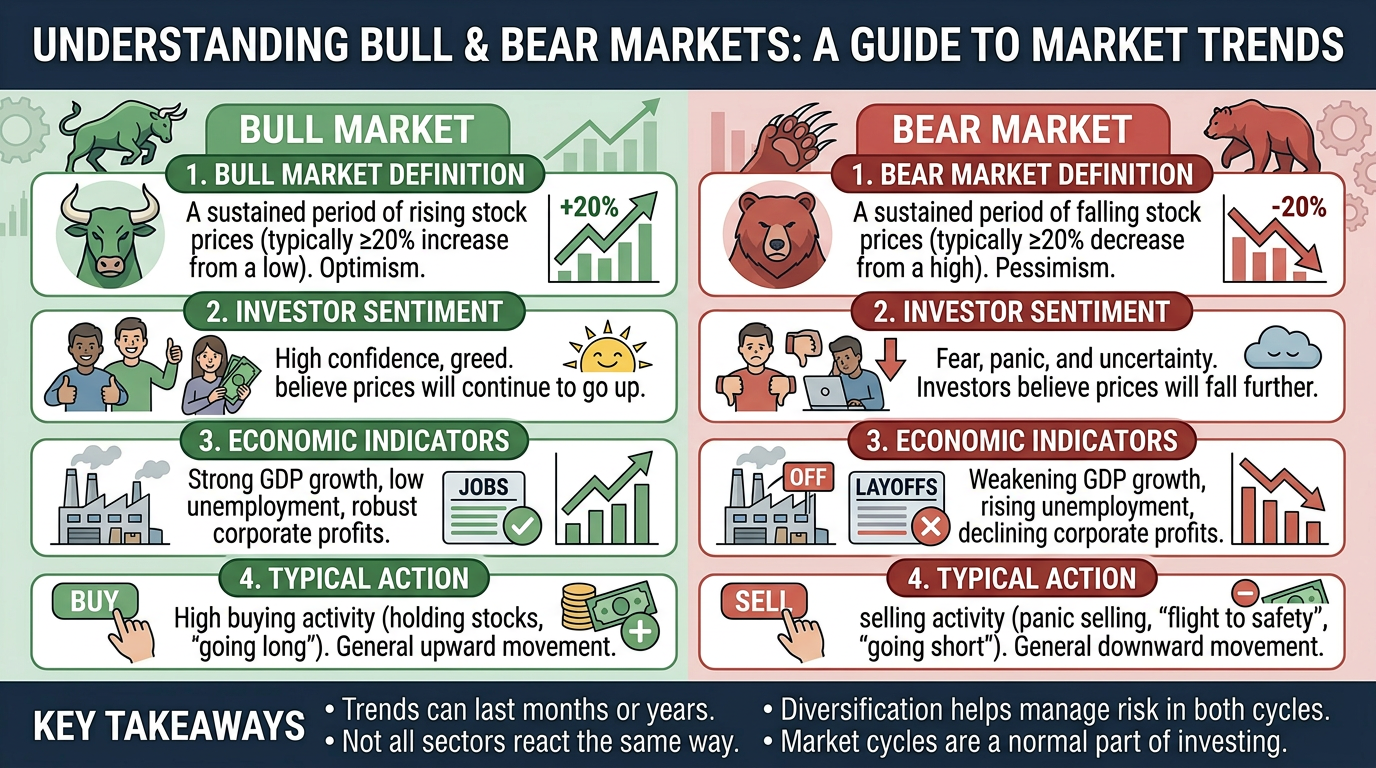
A bull market refers to a period when stock prices are rising over time, often accompanied by strong investor confidence and economic growth. During a bull market, investors are generally optimistic, expecting prices to continue increasing. This leads to more buying activity, which can push prices even higher. Bull markets are typically associated with low unemployment, strong corporate earnings, and steady economic expansion. These periods can last for months or even years, depending on broader economic conditions.
What Is a Bear Market
A bear market is the opposite of a bull market and occurs when stock prices are falling over a sustained period. It is commonly defined as a decline of 20 percent or more from recent highs in a major market index. During a bear market, investor confidence turns negative, and fear or uncertainty often leads to increased selling. Bear markets are usually linked to economic slowdowns, rising unemployment, or major disruptions such as financial crises or global events. Like bull markets, they can vary in length and severity.
How They Are Identified
Bull and bear markets are not defined by a single day or short-term movement but by longer-term trends. A common rule is that a 20 percent rise from a market low signals a bull market, while a 20 percent drop from a peak signals a bear market. However, these definitions are guidelines rather than strict rules, and analysts often consider other factors such as economic data, market momentum, and investor sentiment when identifying market phases.
What Causes Market Cycles
Market cycles are influenced by a wide range of factors, including interest rates, inflation, corporate performance, and global events. For example, when interest rates are low and the economy is growing, borrowing and spending tend to increase, which can support a bull market. On the other hand, rising interest rates, high inflation, or economic uncertainty can slow growth and contribute to a bear market. Investor psychology also plays a major role, as optimism can drive markets higher while fear can accelerate declines.
How Investors React
Investor behavior often changes depending on whether the market is bullish or bearish. In a bull market, investors may be more willing to take risks, invest in growth stocks, and hold positions for longer periods. In a bear market, investors may become more cautious, focusing on preserving capital, reducing risk, or shifting into more stable investments. Some may even try to profit from falling prices through strategies like short selling, although this is more advanced and carries additional risk.
Summary
Bull and bear markets describe the overall direction of the stock market, with bull markets representing rising prices and optimism, and bear markets representing falling prices and caution. These cycles are driven by economic conditions, investor sentiment, and global events, and they can last for extended periods. By understanding how these market phases work, investors can better navigate changes in the market and make more informed investment decisions.
