Trading Hours: When the Stock Market Is Open
Trading hours refer to the specific times when investors can buy and sell stocks on an exchange, and understanding them is an important part of learning how markets actually function. While many people assume the stock market is only open during the day, modern electronic trading has created multiple sessions that extend beyond traditional hours. In the United States, the two primary exchanges, New York Stock Exchange and NASDAQ, follow a standard schedule, but trading activity can begin hours before the official opening time and continue well after the closing time. Each session has different levels of activity, different risks, and different types of participants, which all influence how prices move and how trades are executed.
Regular Market Hours
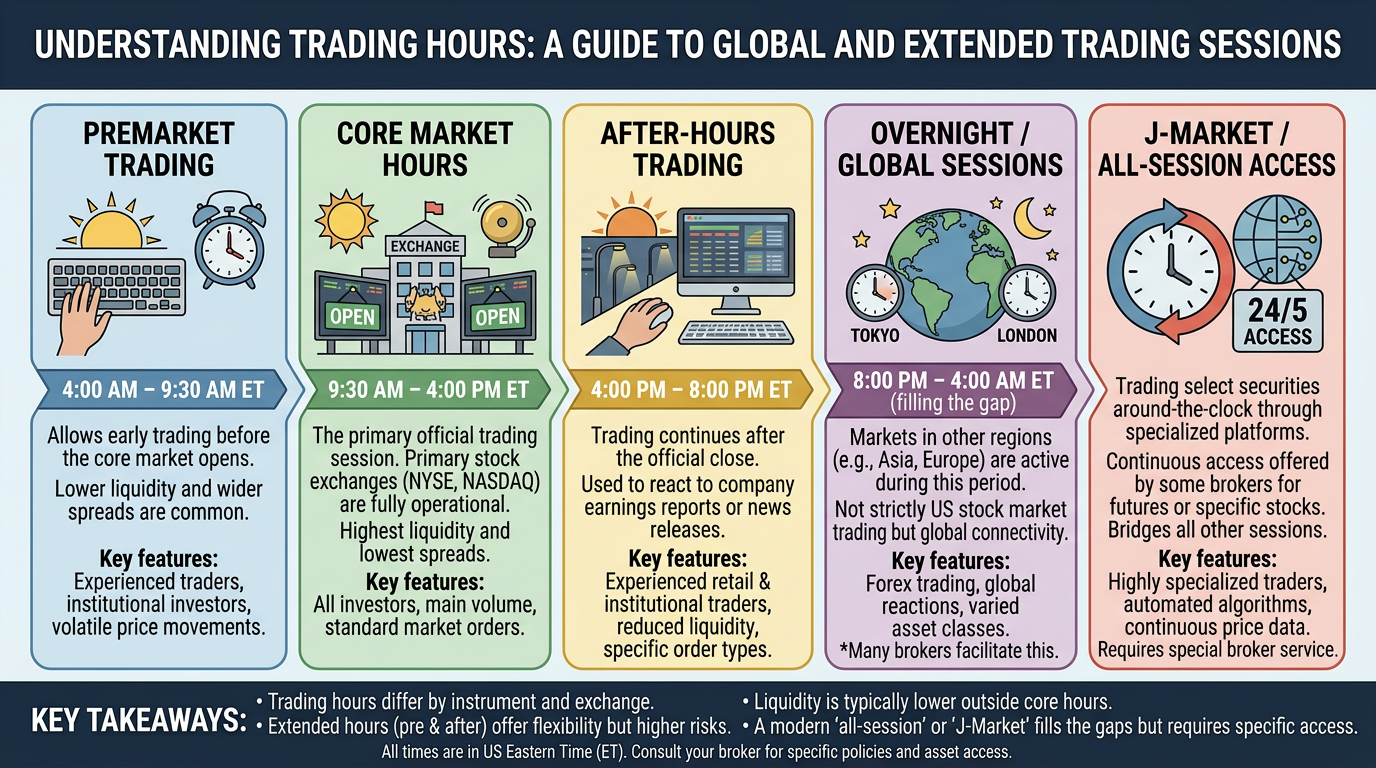
The regular trading session, often referred to as “market hours,” runs from 9:30 AM to 4:00 PM Eastern Time, Monday through Friday, excluding market holidays. This is the core of the trading day and the period when the majority of buying and selling takes place. During these hours, institutional investors such as mutual funds, hedge funds, and large financial institutions are actively trading alongside retail investors (individual investors), which creates high trading volume and strong liquidity. Liquidity refers to how easily a stock can be bought or sold without significantly affecting its price, and during regular hours, liquidity is at its highest. Because so many participants are active, trade execution is more efficient and predictable. For most investors, especially beginners, regular market hours provide the most stable and reliable environment for trading.
Pre-Market Trading
Pre-market trading takes place before the official market open, typically beginning around 4:00 AM and continuing until 9:30 AM Eastern Time, although the exact start time depends on the broker or platform being used (for example, Fidelity starts at 7:00 AM, while Robinhood allows 24 hour trading). This session exists to allow investors to react early to new information that becomes available outside of regular hours, such as corporate earnings announcements, economic reports, geopolitical events, or developments in international markets. Because these events can significantly impact investor expectations, stock prices may begin adjusting before the market officially opens. However, pre-market trading involves far fewer participants than regular hours, which results in lower liquidity and more volatile price movements, meaning that a stock’s price can change quickly and may not reflect where it will trade once the regular session begins. As a result, while pre-market trading can offer early opportunities, it also introduces additional uncertainty and execution risk.
After-Hours Trading
After-hours trading begins immediately after the regular session ends at 4:00 PM Eastern Time and typically continues until around 8:00 PM Eastern Time. This session allows investors to respond to news that is released after the closing bell, which is especially important because many companies report earnings during this time. Earnings announcements often lead to significant price reactions, and after-hours trading gives investors a chance to act on that information without waiting until the next day. Like pre-market trading, however, after-hours activity is characterized by lower volume and reduced liquidity compared to regular hours. This can result in sharper price swings and less consistent pricing, as fewer buyers and sellers are available to stabilize the market. It is also common for prices seen in after-hours trading to differ from the opening price the next morning, as more participants enter the market and reassess the new information.
Overnight Trading
Overnight trading is a newer development that extends trading availability even further, in some cases allowing activity to continue nearly 24 hours a day during the trading week. This type of trading is made possible through electronic communication networks and alternative trading systems rather than traditional exchange floors. Overnight sessions are designed to accommodate global investors and those who want to react to international market movements in real time, since financial markets around the world operate in different time zones. Despite this increased accessibility, overnight trading generally has very low participation compared to other sessions, which can lead to significant price gaps and unpredictable movements. Not all stocks are available for overnight trading, and the conditions can vary widely depending on the platform. Because of the combination of limited liquidity and higher volatility, overnight trading is typically considered more advanced and carries greater risk.
Extended Hours (“J-Hours”)
Some brokerage platforms offer expanded access to trading that combines multiple non-standard sessions into a broader window, sometimes informally referred to as “J-hours.” These extended hours are not official exchange sessions but are instead provided by brokers through electronic systems that connect buyers and sellers outside of traditional market times. J-hours may include pre-market, after-hours, and even overnight trading in a single continuous range, giving investors greater flexibility in when they can place trades. However, the exact structure of these hours, including which securities are available, how orders are executed, and what types of orders are allowed, can vary significantly between brokers. Because these sessions rely heavily on electronic matching rather than centralized exchange activity, they share the same characteristics as other extended sessions, including lower liquidity, wider spreads, and increased volatility.
Why Trading Hours Matter
The timing of a trade can have a meaningful impact on both the price received and the overall risk involved. During regular market hours, the high level of participation creates a more efficient and stable environment, making it easier to enter and exit positions at expected prices. In contrast, trading outside of these hours exposes investors to conditions where prices can move more abruptly and where fewer participants are available to absorb large orders. This can lead to slippage, where a trade is executed at a different price than anticipated, and can make it more difficult to accurately assess a stock’s true market value at that moment. At the same time, extended hours provide flexibility and the ability to react quickly to new information, which can be valuable in certain strategies. Understanding how each session operates helps investors choose when to trade based on their goals, experience level, and tolerance for risk.
Summary
Stock trading is not limited to a single part of the day but instead occurs across multiple sessions, each with its own characteristics. Regular market hours from 9:30 AM to 4:00 PM Eastern Time offer the highest liquidity and most stable conditions, making them the most common and beginner-friendly period for trading. Pre-market and after-hours sessions allow investors to respond to news outside of regular hours but involve lower volume and greater volatility. Overnight trading and extended “J-hours” further expand access to the market, though they introduce additional complexity and risk due to limited participation. By understanding how these different trading windows function, investors can make more informed decisions about when to trade and how to manage the risks associated with each session.
