The Stock Market: Structure, Function, and Core Mechanics
The stock market isn’t just for Wall Street, it’s where companies raise money to grow and investors of all sizes can buy a piece of that growth. Understanding how it works is key to seeing how money, business, and opportunity move in the economy.
What Is the Stock Market?
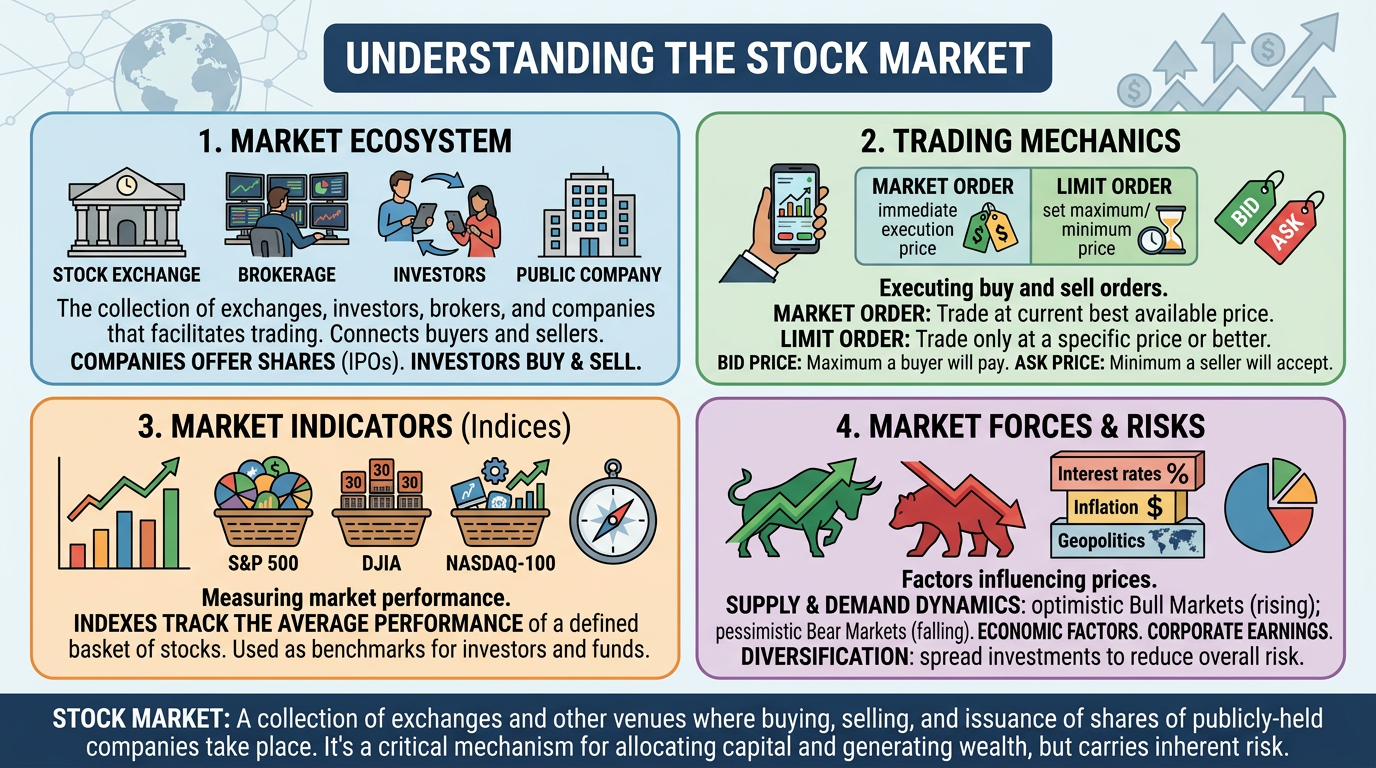
The stock market refers to the entire system where shares of publicly traded companies are issued, bought, and sold. While people often talk about it as if it were a single place, it is actually a network of exchanges, institutions, and participants that work together to facilitate trading. At its core, the stock market exists to connect companies that need capital (money) with investors who are willing to provide that capital in exchange for ownership. When you buy a stock, you aren’t just making a trade, you are buying a small piece of the company and a share of its future growth and profits.
The stock market is important because it allows companies to raise money while giving investors a way to buy and sell shares easily. Companies can get funding without taking on debt, and investors can move in and out of investments when they want. This balance keeps the market running efficiently and continuously.
Public Companies and the Transition to the Market
A public company is one whose shares are available for trading by the general public. Before reaching this stage, most companies are privately owned, meaning their shares are held by founders, early investors, or private firms. The transition to becoming public typically happens through an Initial Public Offering (IPO), where the company sells shares to investors for the first time.
Going public is a major shift for a company because it introduces new responsibilities. Public companies are required to disclose detailed financial information on a regular basis, including revenue, profits, risks, and future outlook. This transparency is essential because it allows investors to evaluate the company and decide whether its stock is worth buying or selling.
Once a company is public, its ownership becomes widely distributed among shareholders. These shareholders technically own the company, but control is usually exercised through voting rights and a board of directors, which is a group of people chosen to make major decisions on behalf of the company. This separation between ownership and management is a defining feature of modern public markets.
Primary vs. Secondary Markets
To understand how money actually flows through the stock market, it is important to distinguish between the primary and secondary markets. The primary market is where new shares are created and sold directly by a company to investors. This is where capital is raised, typically during an IPO or a follow-up offering. After shares are issued, they begin trading in the secondary market, which is what most people think of as “the stock market.” Here, investors buy and sell shares with each other rather than from the company itself. This means that when you purchase a stock on an exchange, your money is usually going to another investor, not the company.
This distinction is critical because it highlights the stock market’s dual role. The primary market helps companies get the money they need to grow, while the secondary market makes it easy for investors to buy and sell shares and adjust their holdings at any time.
Stock Exchanges and Market Infrastructure
Stock exchanges are the backbone of the stock market, providing the systems and rules that allow trading to occur. In the United States, the most prominent exchanges are the New York Stock Exchange and the NASDAQ. These exchanges ensure that trades are executed fairly, efficiently, and transparently.
Behind the scenes, exchanges rely on complex electronic systems that match buyers and sellers in fractions of a second. They also enforce listing requirements, which companies must meet in order to have their shares traded publicly. These requirements often include minimum size thresholds, financial disclosures, and governance standards.
In addition to exchanges, the broader market infrastructure includes brokers (who execute trades on behalf of investors), clearinghouses (which ensure trades are completed properly), and market makers (who provide liquidity by continuously offering to buy and sell stocks). Liquidity is how easily an asset, like a stock, can be bought or sold without affecting its price. Together, these components create a highly coordinated system that allows billions of dollars to be traded daily.
Price Formation and the Role of Supply and Demand
Stock prices are determined through a continuous auction process driven by supply and demand. At any given moment, there are buyers willing to pay a certain price (bids) and sellers willing to accept a certain price (asks). When these prices align (when the price the buyer is willing to pay is equal to the price the seller is willing to sell for), a trade occurs, and that transaction sets the current market price.
However, this process is not random. It reflects the collective judgment of millions of investors who are constantly analyzing information and forming expectations about the future. Factors such as earnings reports, economic data, interest rates, and global events all influence whether investors are more inclined to buy or sell. Importantly, stock prices are forward-looking. They do not just represent what a company is worth today, but what investors believe it will be worth in the future. This is why prices can rise even when current performance is weak, or fall despite strong results, expectations matter just as much as reality.
Market Participants and Their Roles
The stock market is driven by a wide range of participants, each with different goals, resources, and strategies. Individual investors make up a large portion of the market and typically invest for long-term growth or personal financial goals. Institutional investors, such as mutual funds, pension funds, and hedge funds, manage large pools of capital and often have a greater influence on price movements due to the size of their trades.
Market makers play a particularly important role by providing liquidity. They constantly offer prices to buy and sell stocks, making sure someone is always available to complete a trade. Without market makers, it would be much harder to buy or sell shares quickly. There are also high-frequency traders and algorithmic trading firms that use advanced technology to execute trades at extremely high speeds. While their strategies are complex, their presence contributes to overall market liquidity and efficiency.
Liquidity, Efficiency, and Information Flow
Being able to buy and sell stocks quickly is an important part of a healthy stock market. When a market works this way, investors can enter or exit positions easily without causing big changes in prices. This is especially important for investors handling large amounts of money, who need to trade without affecting the market too much.
A related idea is market efficiency. In an efficient market, stock prices quickly reflect all available information. As companies release earnings reports and news or as economic data comes out, prices adjust to match updated expectations. Because information is incorporated so quickly, it is hard for most investors to consistently beat the market (which is to earn more money from your investments than the overall stock market does over the same period). By the time new information reaches most people, it has usually already been reflected in stock prices.
Market Indexes and Benchmarking
Market indexes provide a way to measure the overall performance of the stock market or specific segments of it. Instead of tracking individual stocks, indexes group together multiple companies to give a broader view. For example, the S&P 500 tracks 500 of the largest U.S. companies and is often used as a benchmark for the overall market. The Dow Jones Industrial Average focuses on 30 major corporations, while the Nasdaq Composite includes a large number of technology and growth-oriented companies. Investors use these indexes to evaluate performance, compare investments, and understand broader market trends.
Regulation and Market Integrity
The stock market operates under strict regulations designed to ensure fairness, transparency, and investor protection. Public companies must disclose accurate financial information, and trading practices are monitored to prevent fraud and manipulation. These regulations are essential because they build trust. Without confidence that the market is fair and transparent, investors would be less willing to participate, which would reduce liquidity and harm the overall system.
Conclusion
The stock market is a structured system where shares of public companies are issued and traded, connecting businesses that need capital with investors who want to participate in their growth. Companies raise money in the primary market, while investors trade shares in the secondary market, and stock prices are determined by supply and demand, reflecting expectations about the company’s future. Supported by exchanges, brokers, market makers, and regulations, the stock market provides liquidity, transparency, and a mechanism for allocating capital efficiently. Understanding how shares are issued, how prices are formed, and how different participants interact is essential for anyone looking to invest or simply understand how modern financial markets operate.
