Initial Public Offerings: When a Private Company Goes Public
The transition of a company from being privately owned to publicly traded is a major financial event called an Initial Public Offering (IPO). This process is how a company’s stock first becomes available for purchase by the general public. It is a critical milestone that helps businesses raise capital for expansion and provides an exit for early private investors.
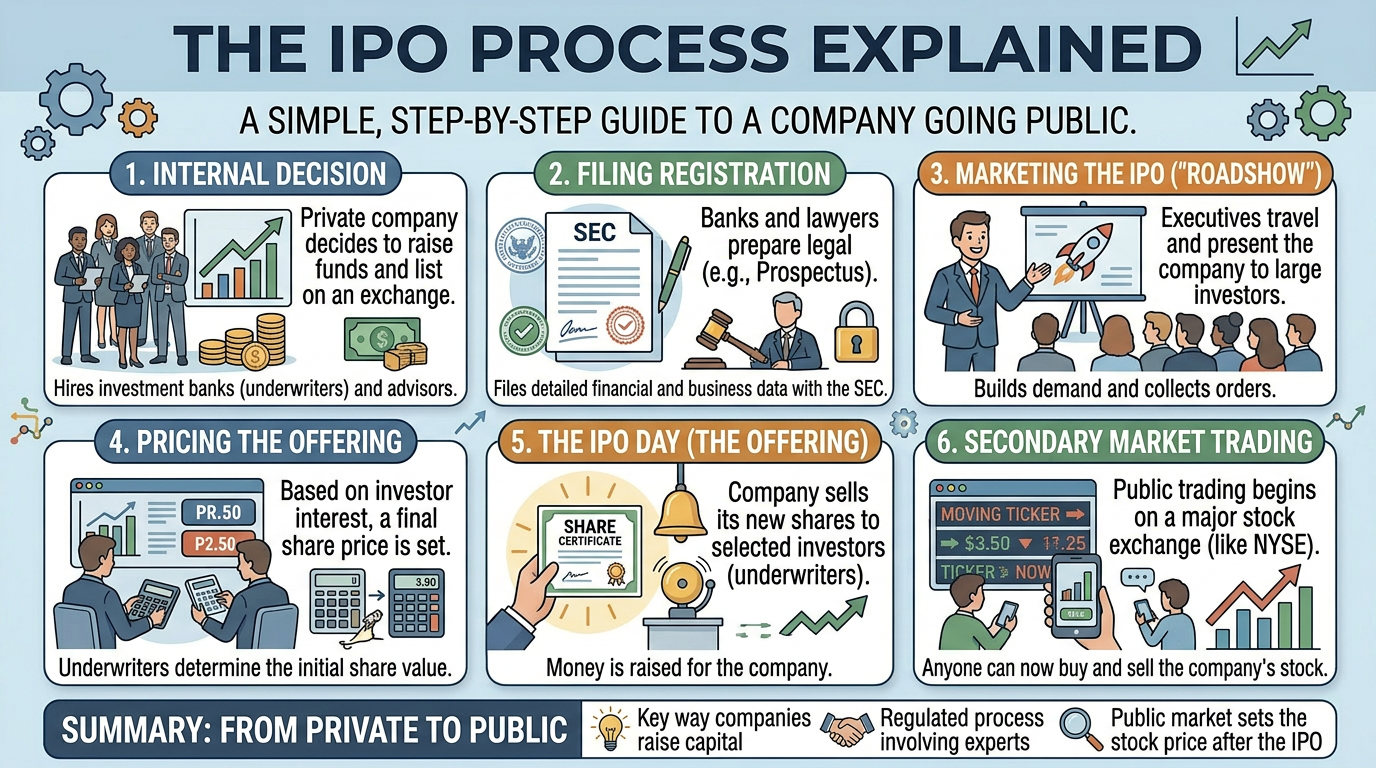
What is an IPO?
An Initial Public Offering (IPO) occurs when a private company sells shares of its ownership to the general public for the very first time on a stock exchange. After this event, the company is known as a public company, and its shares can be bought and sold freely on the market by anyone. Before an IPO, a company’s ownership is typically held only by its founders, employees, and private investors, such as venture capital or private equity funds. The IPO is the moment the company "opens up" its ownership to the world.
Why Companies Go Public
The primary motivation for a company to pursue an IPO is to raise a large amount of capital (money) to fund significant growth initiatives. By selling ownership stakes (shares) to new investors, the company secures funding that can be used for several purposes. This capital is often directed toward expansion, such as hiring more staff, funding new projects, or building new facilities. The funds can also be used for strengthening the company’s financial health by paying off existing debt. Crucially, the IPO provides a critical exit opportunity for early investors, allowing them to sell their shares to the public and realize the large returns they earned from supporting the company in its early stages.
The IPO Process (Simplified)
The process of going public is complex and typically spans several months. It begins with the private company hiring major investment banks, known as underwriters, to manage the sale. These underwriters help the company prepare necessary legal documents and financial disclosures, and they work to determine the initial price at which the stock will be offered. The initial issuance of new shares takes place in the primary market, where the stock is sold directly by the company to large institutional investors. The company directly receives the capital raised from this primary sale. On the designated "IPO day," the shares are officially listed on a stock exchange like the NYSE or NASDAQ and begin trading. All subsequent trades between investors take place in the secondary market, which is commonly recognized as the stock market. If you are interested, you can find a much more in-depth and complicated version here [embed].
IPOs and Individual Investors
For most everyday investors, the IPO provides the first opportunity to own a piece of a company you believe in, allowing you to participate directly in its future growth. However, stocks that have recently completed an IPO can be highly volatile, meaning prices move up and down a lot. Because the company is new to the public market, the trading often experiences intense excitement or over-excitement, which can lead to sharp price swings that are much more unpredictable than the shares of established companies. Due to this increased volatility and risk, some investors choose to wait until a company has been publicly traded for a while to allow the stock price to stabilize and for the market to form a clearer value for the company.
Summary
The Initial Public Offering is the crucial first step where a private company sells its shares to the public to raise capital. It marks the transition to becoming a public company and is where the initial shares are sold in the primary market. While an IPO offers investors an exciting opportunity to buy into a growing company, these stocks often experience higher volatility and risk than more established, long-term investments.
