Stock Splits: Adjusting the Price, Not the Value
The price of a single share of stock can sometimes climb very high, which may discourage smaller individual investors from buying a full share. To address this, a company may divide each of its existing shares into multiple new shares. This action reduces the price per share but, importantly, does not change the company's overall value.
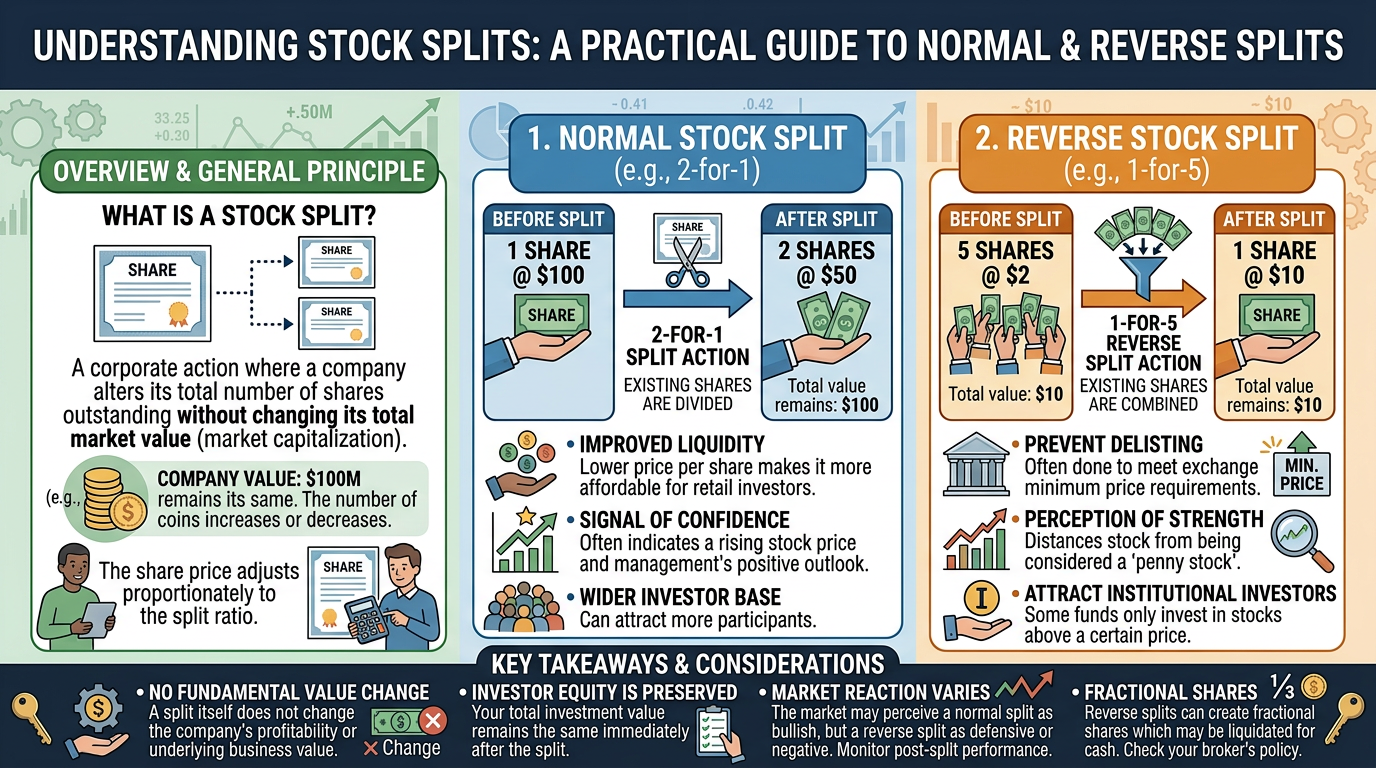
What is a Stock Split?
A stock split happens when a company divides its existing shares into a greater number of shares. The primary effect is to reduce the market price per share without fundamentally changing the value of the company or the value of an investor's ownership stake. For instance, a common split ratio is 2-for-1 or 3-for-1, but companies can use any ratio. This process is purely mechanical, adjusting the number of shares and their corresponding price.
In a 2-for-1 stock split, an investor who previously owned one share priced at $100 will own two shares after the split, with each new share priced at $50. The total value held by the investor remains $100. If you owned 10 shares worth $100 each, you would now possess 20 shares worth $50 each. The core objective is to lower the per-share price, making the stock more affordable and lowering the barrier to entry for individual investors seeking to purchase whole shares.
The Impact of a Stock Split
A stock split does not alter the fundamental value of the company. The company is not raising new capital, and its future profit outlook is unchanged. The main benefits are psychological and practical. Psychologically, a lower share price can make the stock seem more attractive or "cheaper" to new investors. Practically, a lower price can increase the liquidity of the stock, which means it is easier to buy and sell on the market. Companies also perform splits to keep their share price within a certain preferred trading range. This is especially true for companies that are included in price-weighted indexes like the Dow Jones Industrial Average, where a very high stock price can disproportionately influence the overall index.
What is a Reverse Stock Split?
The opposite action is known as a reverse stock split. This is where a company reduces the total number of its outstanding shares, which simultaneously increases the price per share. For example, a 1-for-10 reverse split would convert ten shares trading at $1 into one share trading at $10. Reverse stock splits are typically executed when a stock’s price has fallen very low, often below the minimum required price (like $1) to remain listed on a major exchange such as the NASDAQ. By raising the share price, the company can meet the minimum listing requirements. However, this move is sometimes viewed by the market as a sign that a company is struggling financially.
Summary
A stock split is a mechanical adjustment that divides one share into multiple shares, effectively lowering the price per share without changing the company's total market capitalization. It is primarily used to increase a stock's affordability and improve its liquidity for investors. The opposite action, a reverse stock split, is used to increase the share price, most often to prevent delisting from an exchange. In both scenarios, the core value of the underlying company is identical immediately after the split.
