Stocks: What They Are and How They Work
If you’ve ever heard people talk about the stock market, investing, or companies like Apple or Amazon, they are usually referring to stocks. Stocks are one of the most common ways people invest money, and they play a major role in the global economy. But what exactly is a stock, and how does it actually work?
What Is a Stock?
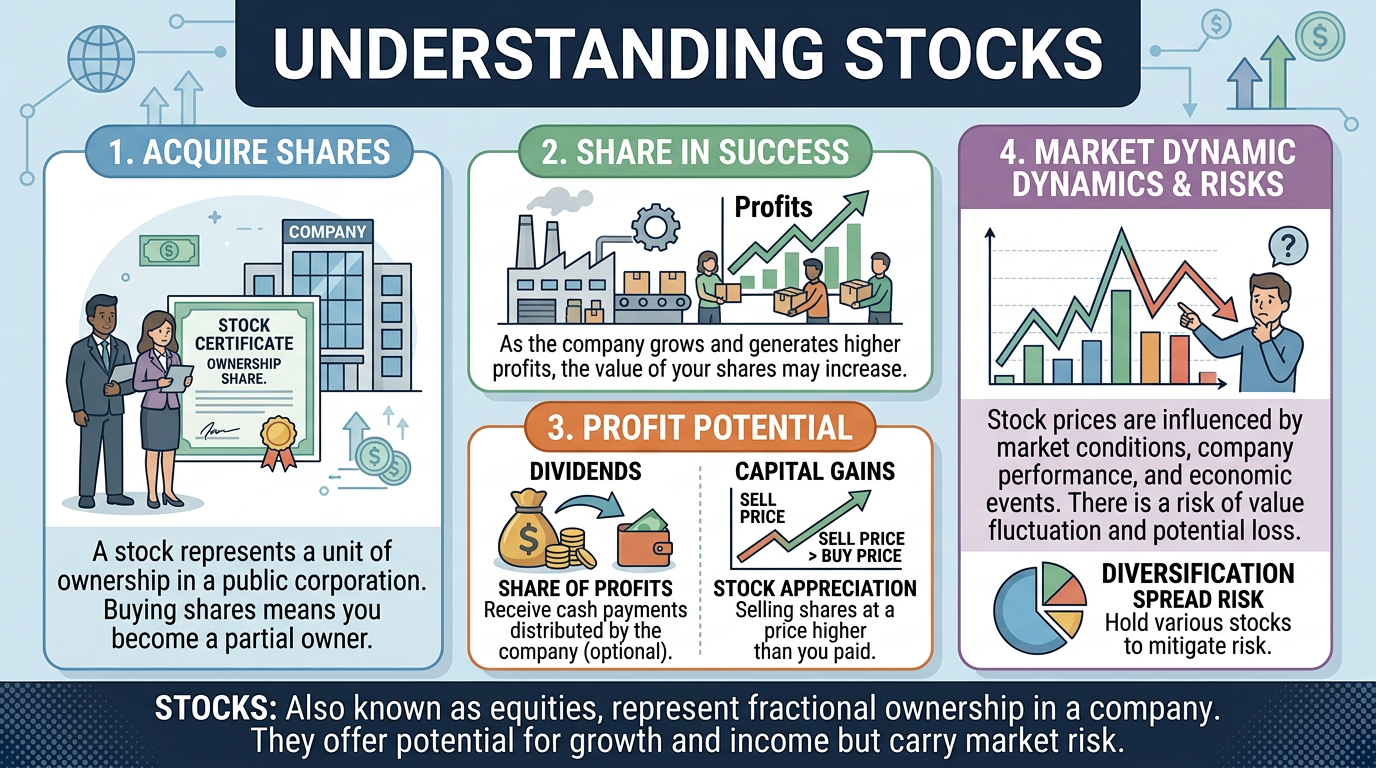
A stock represents ownership in a company. When a company is divided into shares and you buy one of those shares, you now own a small part of that business. If the company grows and becomes more valuable, your share becomes more valuable as well. If the company struggles, your investment can lose value. For example, imagine a company is split into 1,000 shares. If you own 10 shares, you own 1% of that company.
Why Do Companies Issue Stocks?
Companies sell stocks to raise money. Instead of borrowing money (like taking a loan), a company can sell ownership in the business to investors. This allows them to fund things like expanding operations, building new products, or entering new markets.
This process often starts with an IPO (Initial Public Offering), where a private company sells its shares and becomes publicly traded for the first time. After that, its shares can be bought and sold freely on the market.
Where Are Stocks Traded?
Stocks are bought and sold on exchanges, which act like organized marketplaces where investors can trade shares. In the U.S., the two most well-known stock exchanges are the New York Stock Exchange and the NASDAQ. These exchanges provide a structured system to ensure trades happen efficiently, fairly, and transparently, with prices determined by supply and demand.
Today, most trading happens electronically, allowing investors to buy and sell stocks instantly through apps and brokerage accounts. This digital system has made investing more accessible than ever, letting individual investors participate alongside large institutions, and providing real-time price updates, charts, and research tools to help guide investment decisions. Exchanges also enforce rules and regulations to protect investors and maintain confidence in the market, making them the backbone of the stock trading system.
How Do Stock Prices Change?
Stock prices are constantly moving based on supply and demand. If more people want to buy a stock than sell it, the price goes up. If more people want to sell than buy, the price goes down.
Several factors influence this, including company performance (revenue, profits, growth), economic conditions (interest rates, inflation), news and investor sentiment, and industry trends. In simple terms, stock prices reflect what investors believe a company is worth right now, and what it might be worth in the future.
How Do You Make Money From Stocks?
1. Price Appreciation (Increase) - This is when you buy a stock at one price and sell it later at a higher price. For example, if you buy a stock at $100 and sell it at $150, you make a $50 profit.
2. Dividends - Some companies pay dividends, which are regular payments to shareholders. These usually come from profits. Larger, more established companies are more likely to pay dividends, while fast-growing companies often reinvest their profits instead.
Risks of Investing in Stocks
Stocks offer strong long-term growth potential, but they also come with risk. Prices can be very volatile (move up and down a lot) in the short term. A stock can drop quickly due to bad earnings, negative news, or broader market downturns.
Because of this, many investors diversify, meaning they spread their investments across multiple stocks or funds instead of relying on just one. A common saying in investing is, “don’t put all your eggs in one basket,” which reflects the idea of reducing risk by not depending too heavily on a single investment.
Long-Term Investing vs Short-Term Trading
1. Long-term investing involves buying stocks and holding them for years, sometimes even decades, with the goal of benefiting from the company’s overall growth over time. Instead of worrying about short-term price movements, long-term investors focus on things like the company’s earnings, competitive position, and future potential. This approach relies on the idea that, despite short-term ups and downs, the stock market tends to rise over the long run as businesses grow and generate more profits.
2. Short-term trading involves buying and selling stocks frequently, sometimes within days, hours, or even minutes, to try to profit from price movements. Traders often rely on charts, patterns, news, and market trends rather than focusing deeply on a company’s long-term fundamentals (how the company is doing). While this approach can lead to quick gains, it is much more unpredictable and requires constant attention, quick decision-making, and a higher tolerance for risk.
Most beginner investors focus on long-term investing because it is generally less risky, less stressful, and does not require constant monitoring. It also allows investors to take advantage of compounding, where returns build on top of previous returns over time, helping grow wealth more steadily.
Conclusion
Stocks are ownership shares in companies that allow investors to participate in their success. They can generate returns through rising prices and dividends, but they also come with risk due to market fluctuations. By understanding how stocks work and focusing on long-term investing, they can become one of the most powerful tools for building wealth over time.
