A Simple Guide to the Different Types of Stocks
Different stocks represent different kinds of companies and investment strategies. While all stocks give you ownership in a company, they can behave very differently depending on factors like growth, stability, and how the company uses its profits. Understanding the different types of stocks can help you choose investments that match your financial goals, risk tolerance, and long-term strategy.
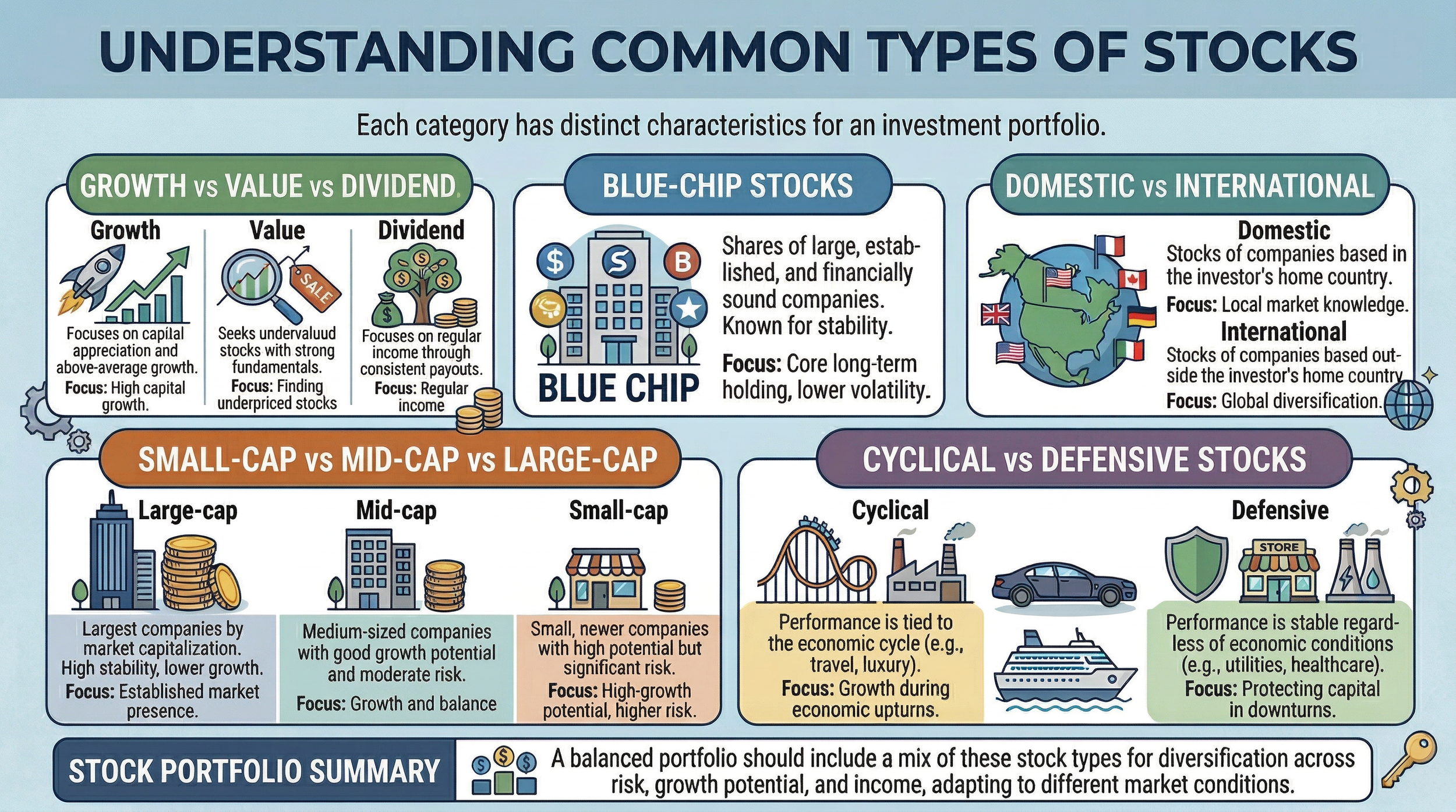
Growth Stocks vs Value Stocks vs Dividend Stocks
Growth stocks are companies that are expected to grow faster than the overall market. Instead of paying dividends, these companies usually reinvest their profits back into the business to expand operations, develop new products, or enter new markets. Many growth stocks are in industries like technology. Growth stocks can offer high returns, but they also tend to be more volatile (their prices move up and down more). This is because their valuations depend heavily on future expectations, which can change quickly.
Value stocks are companies that appear to be undervalued compared to their actual financial performance. This means their stock price may be lower than what investors believe the company is truly worth. These companies are often more established and may not be growing as quickly as growth stocks. Instead, they may be temporarily overlooked or out of favor with investors. Value stocks are generally considered less risky than growth stocks, but they may take longer to increase in price. Investors who buy value stocks are often looking for opportunities to purchase strong companies at a “discount.”
Dividend stocks are companies that regularly pay a portion of their profits to shareholders in the form of dividends (cash payments made to investors for owning shares).. These companies are usually stable, well-established businesses that generate consistent income. For example, companies like Coca-Cola are known for paying regular dividends. Dividend stocks are popular among investors who want steady income, rather than just price growth. They also tend to be less volatile than growth stocks, although their price appreciation may be slower.
Blue-Chip Stocks
Blue-chip stocks are shares of large, well-known companies with a history of stable performance and strong financial health. These companies are typically leaders in their industries and have been around for a long time. Examples include Microsoft and Johnson & Johnson. Blue-chip stocks are considered safer investments compared to smaller or newer companies. While they may not grow as quickly as growth stocks, they tend to be more reliable over the long term.
Small-Cap, Mid-Cap, and Large-Cap Stocks
Stocks are often grouped based on market capitalization (market cap), which is the total value of a company. It is calculated by multiplying the company’s stock price by the total number of shares outstanding.
Large-cap stocks are the biggest companies, usually worth over $10 billion. These are typically well-established businesses that have been around for a long time and are leaders in their industries. They often have stable revenue, strong brand recognition, and consistent profits. Because of this, they tend to be less volatile (less extreme price swings) than smaller companies. However, since they are already so large, their growth is usually slower compared to smaller companies. Many large-cap stocks also pay dividends, making them popular for investors looking for stability and income.
Mid-cap stocks are medium-sized companies, generally valued between about $2 billion and $10 billion. These companies are often in a growth phase, they have already proven their business model works but still have significant room to expand. Mid-cap stocks can offer a balance between growth and stability. They may grow faster than large-cap companies, but they are usually less risky than small-cap stocks. Because of this, they are sometimes seen as a “middle ground” for investors.
Small-cap stocks are smaller companies, typically worth under $2 billion. These companies are often newer or still developing, which gives them the potential to grow quickly. Because of this, small-cap stocks can sometimes deliver very high returns. However, they also come with higher risk. They tend to be more volatile, have less predictable earnings, and may struggle more during economic downturns. Information about them can also be more limited compared to larger companies.
In general, larger companies tend to be more stable but grow more slowly, while smaller companies offer higher growth potential but come with greater risk. This classification helps investors understand the size, stability, and growth potential of a company, making it easier to compare different stocks and build a balanced portfolio.
Domestic Stocks vs International Stocks
Domestic stocks are companies that are based in your home country. For U.S. investors, this means companies located in the United States. Investing in domestic stocks is often simpler because information is easier to access, financial reports follow familiar standards, and regulations are more consistent and easier to understand. There is also no currency exchange risk, meaning you don’t have to worry about changes in foreign exchange rates affecting your returns.
Because of this simplicity, many beginners start with domestic stocks. They are easier to research, follow in the news, and understand, which makes them a good starting point for learning how the stock market works.
International stocks, on the other hand, are companies located outside your home country. These stocks allow you to invest in global markets and reduce reliance on a single economy. For example, investing in companies from Europe or Asia can give you exposure to different industries, economic trends, and growth opportunities that may not exist in the U.S.
However, international stocks come with additional risks. Currency fluctuations can impact returns, political or economic instability in other countries can affect performance, and different regulations or accounting standards can make companies harder to evaluate. Despite these risks, international stocks are often used to diversify a portfolio, helping spread risk across multiple regions and economies.
Cyclical Stocks vs Defensive Stocks
Cyclical stocks are companies whose performance is closely tied to the overall economy. When the economy is strong and people are spending more money, these companies tend to do very well. However, when the economy slows down or enters a recession, their sales and profits often decline.
These companies usually operate in industries where spending is more optional, such as travel, retail, and automobiles. For example, people are more likely to book vacations, buy new cars, or spend on luxury goods when the economy is doing well. Because of this, cyclical stocks can grow quickly during strong economic periods, but they also tend to be more volatile and risky during downturns.
Defensive stocks, on the other hand, are companies that tend to remain stable regardless of economic conditions. These businesses provide essential goods and services that people need no matter what is happening in the economy, such as food, healthcare, and household products.
For example, companies like Procter & Gamble sell everyday necessities that people continue to buy even during recessions. Because demand for these products is consistent, defensive stocks usually experience smaller price swings and are considered more stable. While they may not grow as quickly during strong economic periods, they can help protect a portfolio during uncertain times.
Summary
There are many different types of stocks, each with its own characteristics, risks, and potential returns. Some stocks focus on growth, while others provide steady income or stability. Some are tied closely to the economy, while others remain strong even during downturns. Because stocks vary so widely, understanding these different types can help you build a diversified portfolio that matches your financial goals and risk tolerance. By learning how each type of stock behaves, you can make more informed decisions and better understand how the stock market works.
