Venture Capital Funds: Investing in Startups and High-Growth Companies
Venture capital funds are investment funds that provide money to young companies with the potential to grow quickly. Many of today’s most famous companies received venture capital funding early in their development, helping them grow from small startups into global businesses. In simple terms, venture capital investors are betting on which small startups might become the next Apple or Google. Venture capital plays an important role in the economy because it provides funding to companies that may be too new or risky to receive traditional bank loans or public investment.
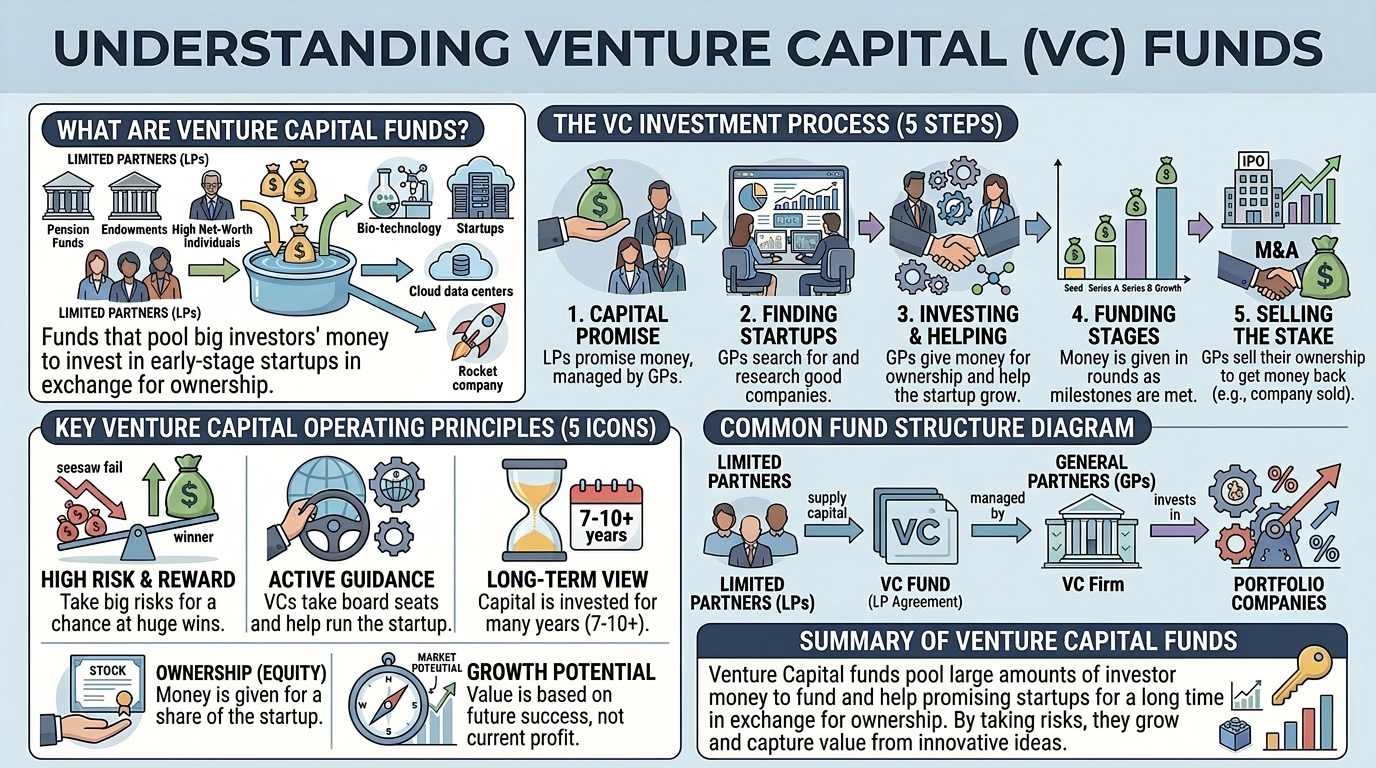
What Is a Venture Capital Fund?
A venture capital (VC) fund is a private investment fund that pools money from investors and uses it to invest in early-stage companies. These investors are often wealthy individuals, pension funds, university endowments, or large institutions. The venture capital fund is managed by professional investors who decide which startups to fund and help guide those companies as they grow.
Unlike traditional stock investing, venture capital funds typically invest in companies that are not yet publicly traded. These companies are often still developing their products, building their customer base, or trying to prove that their idea can become a successful business. Because of this, venture capital investments can be very risky, but they also offer the potential for extremely high returns if a startup becomes successful.
How Venture Capital Funds Invest
Venture capital funds usually invest in companies during specific stages of development. Early-stage investments might be used to build a product, hire employees, or expand operations. Later rounds of funding help companies grow faster, enter new markets, or prepare for a public offering.
In exchange for their investment, venture capital firms typically receive equity, meaning ownership shares in the company. If the company grows and becomes much more valuable, those shares can increase significantly in value. Venture capital investors usually make their profits when a company is sold, merges with another company, or goes public through an initial public offering (IPO).
Because many startups fail, venture capital firms usually invest in many different companies at once. Their strategy is based on the idea that a few very successful companies can make enough money to cover the losses from startups that fail.
How Venture Capital Funds Make Money
Venture capital funds typically follow a model where they raise a large pool of money from investors and then invest that capital over several years. The fund managers guide and monitor the startups they invest in, often helping with strategy, hiring leadership teams, or connecting the company with important business partners.
Like hedge funds, venture capital funds also charge management and performance fees. A common structure is similar to the “2 and 20” model, where the fund charges a management fee on the total money invested and takes a percentage of the profits if the investments perform well. This gives venture capital managers strong incentives to help their portfolio companies grow successfully.
Venture Capital and the Startup Ecosystem
Venture capital plays a major role in the startup ecosystem because it provides funding to companies that may not yet have profits or stable revenue. Traditional lenders like banks often avoid lending to young startups because of the high risk. Venture capital firms are willing to take that risk in exchange for the possibility of large returns if the company succeeds.
In addition to providing funding, venture capital firms often help startups grow by offering business advice, helping recruit experienced executives, and connecting founders with industry contacts. This mentorship can be just as valuable as the money itself.
The Risks and Rewards of Venture Capital
Venture capital investing involves significant risk. Many startups fail because their product does not succeed, competitors outperform them, or they run out of money before becoming profitable. Because of this, venture capital funds expect that a large portion of their investments will not succeed.
However, the few companies that do succeed can grow enormously in value. When a startup becomes a major company through an acquisition or an IPO, the venture capital investors who funded it early can earn extremely large returns. This high-risk, high-reward structure is what makes venture capital such an important part of innovation and entrepreneurship.
Conclusion
Venture capital funds invest in young companies with the goal of helping them grow into successful businesses. By providing funding, mentorship, and industry connections, venture capital firms help startups develop new technologies, services, and ideas that can shape entire industries. While venture capital investing carries significant risk, it has played a major role in the creation of many of today’s most successful companies.
For everyday investors, venture capital funds are usually not directly accessible, but their impact is still visible in the public companies that eventually grow out of these early investments. In many ways, venture capital represents the early stage of the early stage where new companies are created before they eventually reach the stock market.
