Private Equity: The Hidden Forces That Shape Companies and the Economy
Behind the scenes of the economy, there’s a group of investors quietly buying, transforming, and sometimes completely reshaping entire companies. Most people never hear about them, but their decisions can impact jobs, industries, and even the brands you use every day. These are the hidden forces of finance, and they operate through something called private equity.
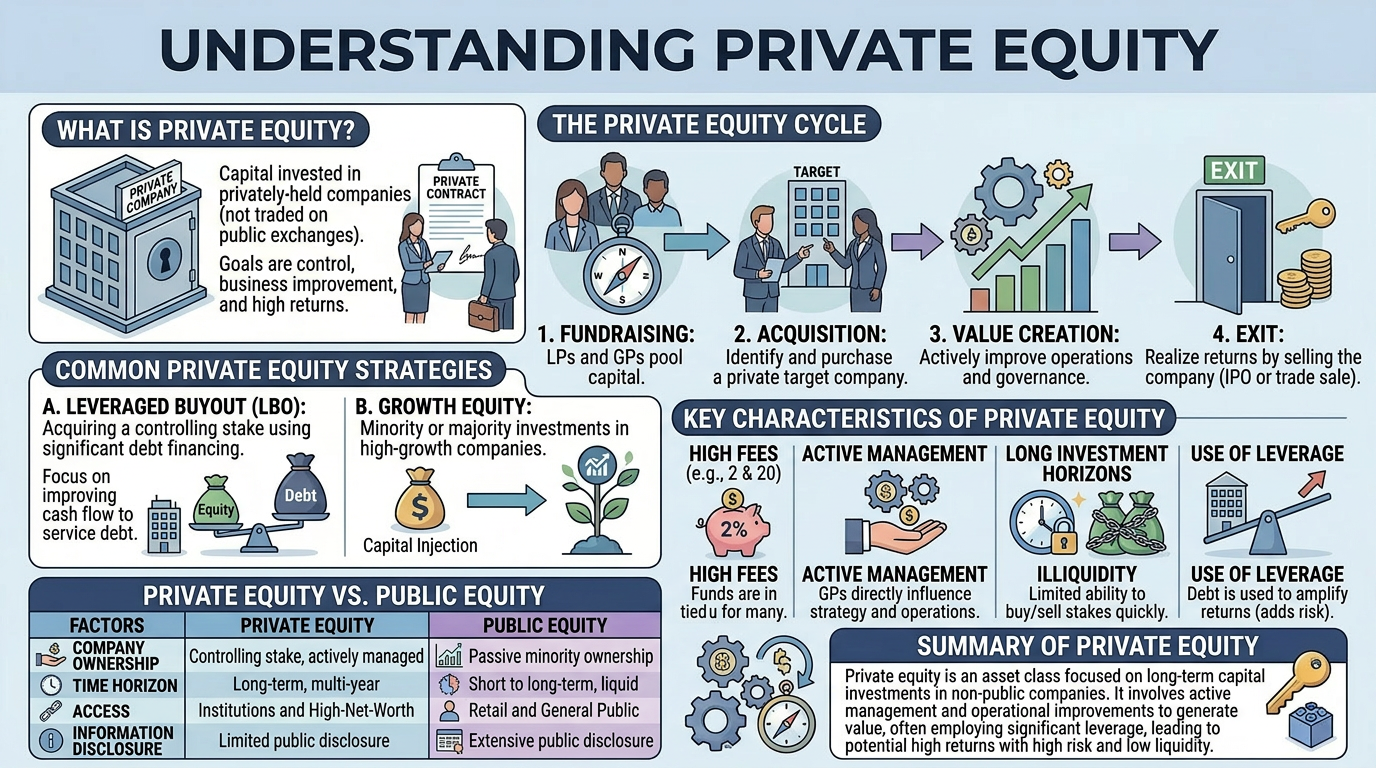
LP = Limited Partners = Investors, GP = General Partners = Those who run the PE firms
What Is Private Equity?
A private equity (PE) fund is a type of investment fund that pools money from investors and uses it to buy companies that are not publicly traded on the stock market. These investors are usually large institutions or very wealthy individuals. Just like hedge funds and venture capital funds, private equity funds are generally not available to normal investors. Instead of buying small pieces of companies (like stocks), private equity firms usually buy entire companies or control stakes in them (control stake = owning enough of the company to make major decisions on how its run).
How Private Equity Is Different
Private equity sits somewhere between hedge funds and venture capital, but it has its own unique style. Hedge funds focus on trading stocks, bonds, and other assets (often short-term), venture capital invests in small, early-stage startups, while private equity usually buys established companies and tries to improve them.
How Private Equity Firms Make Money
Private equity firms follow a simple idea. They buy a company, improve it, and then sell it for more later. This process can take several years (often 5-10 years), and is usually through three main ways.
1. Improving the Business - Private equity firms try to increase a company’s value by cutting unnecessary costs, improving operations, expanding into new markets, and hiring better management. If the company becomes more profitable, it becomes worth more.
2. Using Leverage (Borrowed Money) - One of the most important (and risky) parts of private equity is leverage, which means borrowing money to buy a company.
For example, if a firm wants to buy a company for $1 billion, they might only use $300 million of their own money while borrowing the other $700 million (often from large banks). If the company they buy increases in value, the returns on their original $300 million can be much larger. But if things go badly, losses can also grow quickly,just like with hedge funds. This type of deal is called a Leveraged Buyout (LBO), which is one of the most common private equity strategies.
3. Selling the Company (Exit) - Private equity firms don’t hold companies forever. They eventually “exit” the investment by: selling the company to another firm, merging it with another company, or taking it public through an Initial Public Offering (IPO). An IPO is when a private company sells its shares to the public for the first time on the stock market. They raise money while losing some of the ownership in their company. The final goal of any private equity firm’s investment is to sell the company for much more than they originally paid.
Types of Private Equity Strategies
1. Buyouts (Most Common) - This is when a firm buys a controlling stake in a company, often using leverage, and tries to improve it.
2. Growth Equity - This involves investing in companies that are already growing but need more capital (money) to expand faster. It’s less risky than buyouts because the company is already successful.
3. Distressed Investing - This strategy focuses on struggling or failing companies. Private equity firms buy them at very low prices, try to fix them, and sell them later for a profit.
How Private Equity Firms Get Paid
Private equity funds use a fee structure similar to hedge funds, often called “2 and 20”, which is a 2% management fee (charged yearly on total assets) and an extra 20% of profits (performance fee). This means if the fund performs well, managers can earn huge amounts of money.
Famous Private Equity Firms
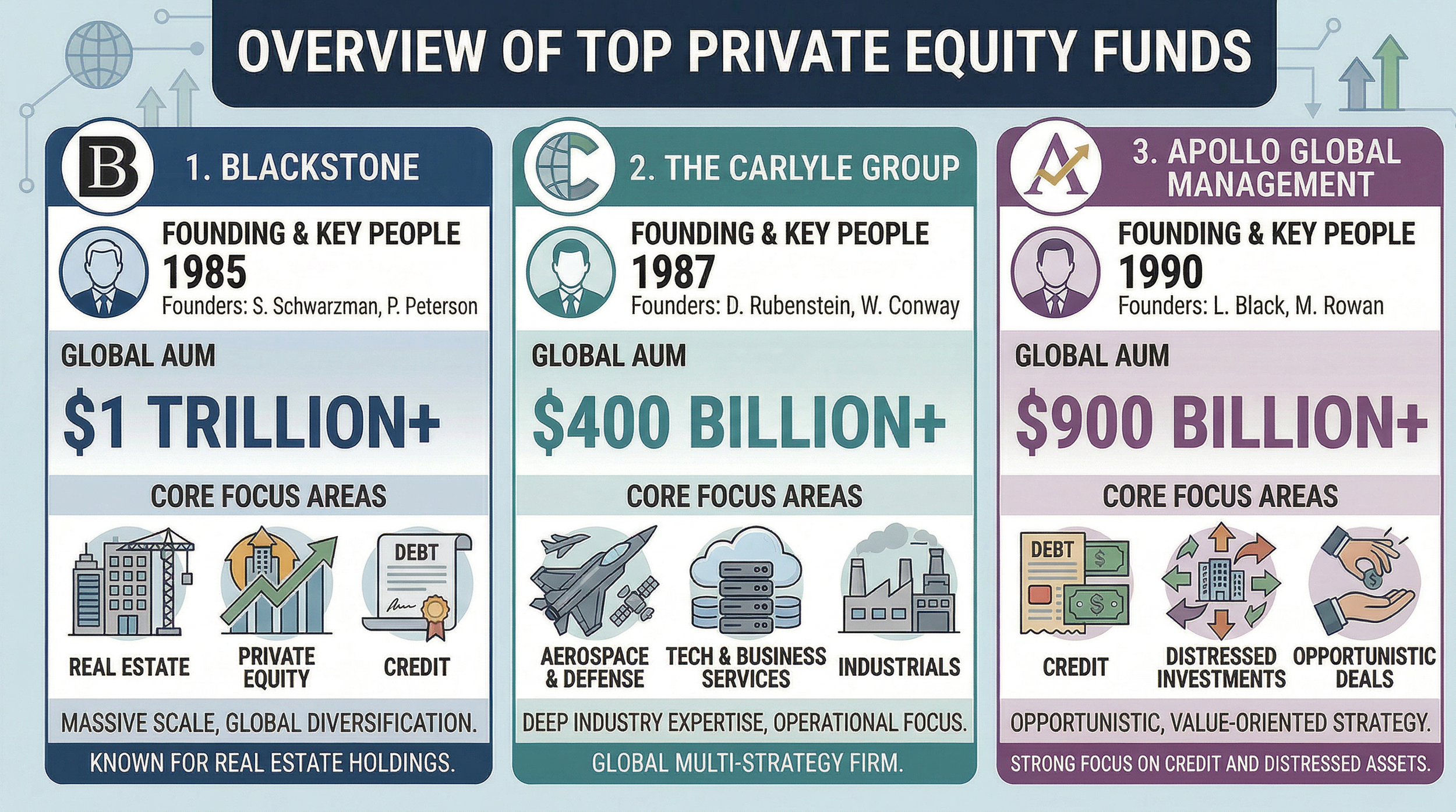
Some private equity firms are extremely large and have influence across entire industries. For example, Blackstone is one of the biggest firms in the world, investing in companies, real estate, and infrastructure, while KKR is well known for helping pioneer leveraged buyouts. The Carlyle Group invests across many different sectors globally, and Apollo Global Management focuses on buyouts and distressed investing. Together, firms like these manage hundreds of billions of dollars and can have a major impact on the overall economy.
Pros and Cons of Private Equity
Private equity offers several advantages for investors. It has the potential for high returns and provides the ability to improve and grow businesses over time. Unlike short-term trading, private equity focuses on long-term investment strategies, allowing firms to make operational improvements, expand into new markets, and increase a company’s overall value.
However, private equity also comes with notable drawbacks. The investments carry very high risk, especially when leverage (borrowed money) is used, which can amplify losses. Companies acquired by private equity may cut jobs or reduce costs aggressively to boost profits. Additionally, private equity funds are usually limited to wealthy individuals or large institutions and tend to be less transparent than public companies, making it harder for outside investors to monitor their investments.
How Private Equity Affects You (Even If You Don’t Invest)
Even if you never invest in private equity directly, it can still have quite a large impact on your life. Private equity firms often own many well-known companies and play a role in shaping how those businesses operate. For example, Burger King, Tim Hortons, and Popeyes are all owned by the private equity firm 3G capital. These firms can influence jobs, wages, and overall business strategies, and they sometimes take companies public, creating investment opportunities for regular investors. In this way, private equity operates quietly behind the scenes, affecting the economy and the companies you interact with every day.
Conclusion
Private equity is all about buying companies, improving them, and selling them for a profit. Unlike hedge funds (which trade markets) or venture capital (which funds startups), private equity focuses on established businesses and uses strategies like leverage and operational improvements to increase their value over time. While private equity can generate very high returns, it also involves significant risk and is generally limited to large investors. For most people, simpler investments like index funds and ETFs remain the most accessible way to build long-term wealth, but understanding private equity helps you see how a huge part of the financial world really works behind the scenes.
