Types of Exchange Traded Funds (ETFs)
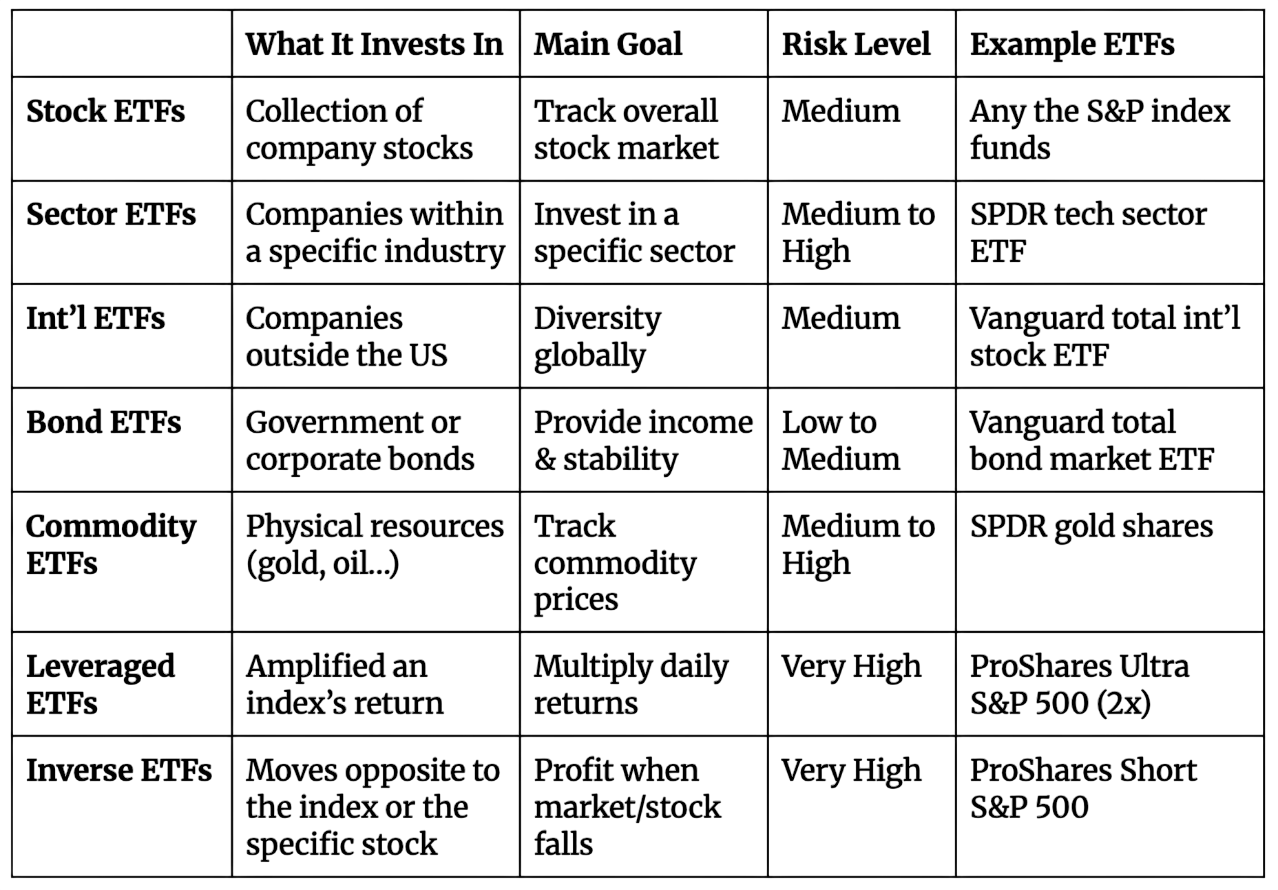
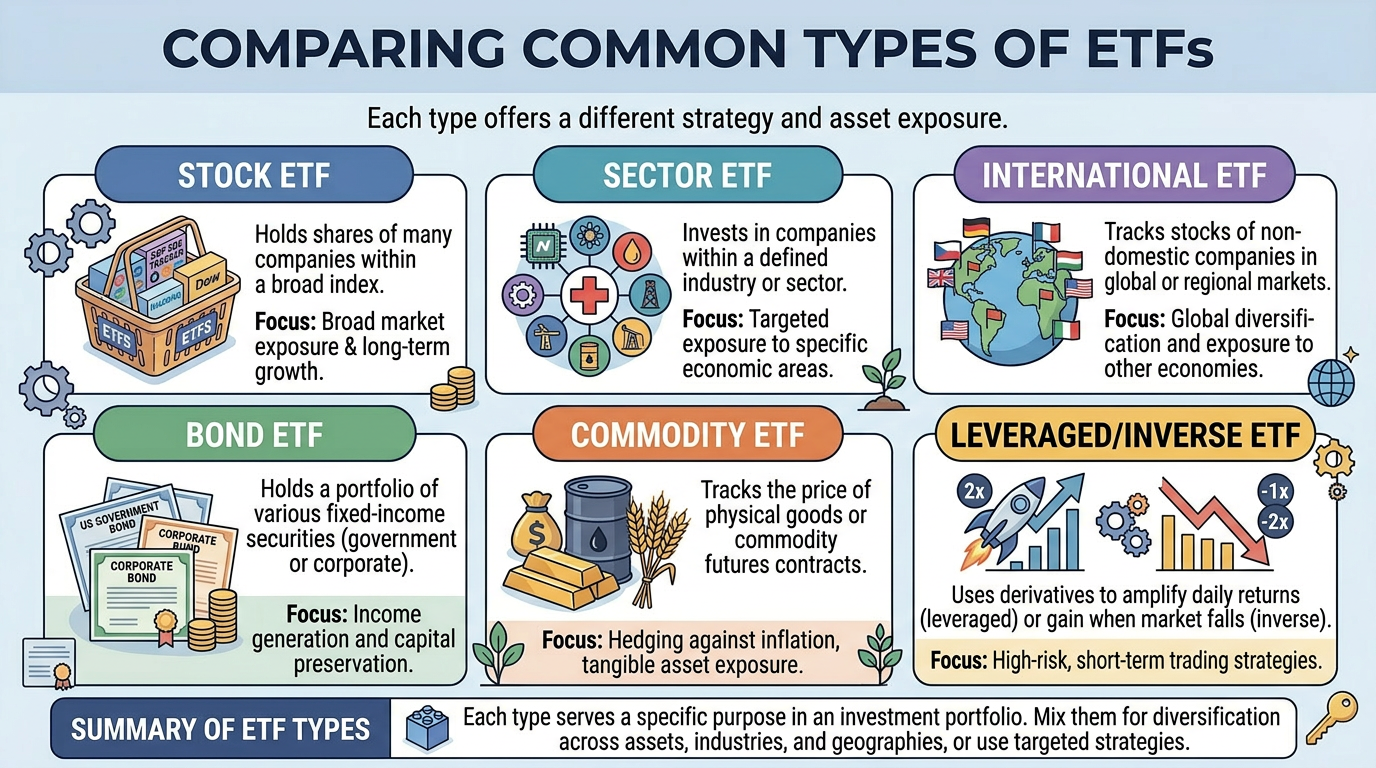
Different ETFs are designed to give you exposure to different parts of the financial markets, such as stocks, bonds, commodities, or specific industries. Understanding the different types of ETFs can help you choose investments that match your financial goals, risk tolerance, and long-term strategy.
Stock ETFs
Stock ETFs are the most common type of ETF. These funds invest primarily in stocks, which represent ownership in companies. Many stock ETFs track major market indexes, allowing you to invest in large groups of companies with a single purchase.
For example, some stock ETFs track the S&P 500, which includes 500 of the largest publicly traded companies in the United States. Popular ETFs that follow this index include the Vanguard S&P 500 ETF and the SPDR S&P 500 ETF Trust. Other stock ETFs may track the entire U.S. stock market, such as the Vanguard Total Stock Market ETF, which holds thousands of companies across many industries.
Sector ETFs
Sector ETFs focus on a specific industry or sector of the economy. Instead of investing across the entire market, these ETFs invest only in companies within a particular field, such as technology, healthcare, or energy.
For example, a technology-focused ETF may invest heavily in companies like Apple and Microsoft, which are major leaders in the technology industry. One example of this type of ETF is the Technology Select Sector SPDR Fund.
Sector ETFs allow you to invest more heavily in industries that you believe will grow quickly. However, because they concentrate on a single sector, they can also experience larger price swings compared to broader market ETFs.
International ETFs
International ETFs invest in companies located outside the United States. These funds allow you to gain exposure to global markets (and reduce dependence on the U.S. market) without needing to buy foreign stocks individually. This can act as another way to diversify.
Some international ETFs focus on specific regions, such as Europe or Asia, while others invest in companies around the world. For example, the Vanguard Total International Stock ETF holds thousands of companies across many different countries.
Commodity ETFs
Commodity ETFs invest in physical resources such as gold, oil, or agricultural products. Instead of tracking companies, these ETFs follow the price of raw materials.
One well-known example is the SPDR Gold Shares, which is designed to track the price of gold. Commodity ETFs are sometimes used by investors who want protection against inflation or who want exposure to natural resources. However, commodity prices can change quickly, which means these ETFs may experience larger price swings than diversified stock market ETFs.
Bond ETFs
Bond ETFs invest in bonds instead of stocks. When you invest in bonds, you are essentially lending money to governments or companies in exchange for interest payments over time.
Because bonds tend to be more stable than stocks, bond ETFs are often used by investors who want lower risk or more consistent income from their investments. One example is the Vanguard Total Bond Market ETF, which invests in a wide range of U.S. government and corporate bonds. Including bond ETFs in your portfolio can help balance risk and reduce the impact of large stock market fluctuations.
Leveraged and Inverse ETFs
Leveraged and inverse ETFs are more complex than most other types of ETFs and are generally not recommended for beginner investors.
Leveraged ETFs attempt to multiply the daily returns of a market index, sometimes aiming to produce two or three times the movement of that index. Inverse ETFs work in the opposite way. Instead of rising when the market rises, they are designed to increase in value when the market falls. Because these funds rely on complex financial strategies and reset their performance daily, their long-term performance can be unpredictable. For this reason, they are typically used by short-term traders rather than long-term investors.
-
The reason why leveraged ETFs and inverse ETFs usually underperform the underlying asset (the asset they are based off of) is due to a concept called volatility decay. Here is an easy example:
An index increases by 10% on Day 1 and decreases by 10% on Day 2.
The total return for the index is 1.10 * 0.90 = 0.99, or a loss of 1%
For a 2x leveraged ETF (double the index’s volatility), the total return for the leveraged ETF is 1.20 * 0.80 = 0.96, or a loss of 4%
Over longer periods of time, this volatility decay can greatly impact returns.