Top ETFs and Investment Strategies for Building a Strong Investment Portfolio
There isn’t a single “best” ETF for everyone because each investor has different goals, risk tolerance, and interests. This guide highlights some popular ETFs and explains what makes them useful, so you can see which ones might fit your investing style.
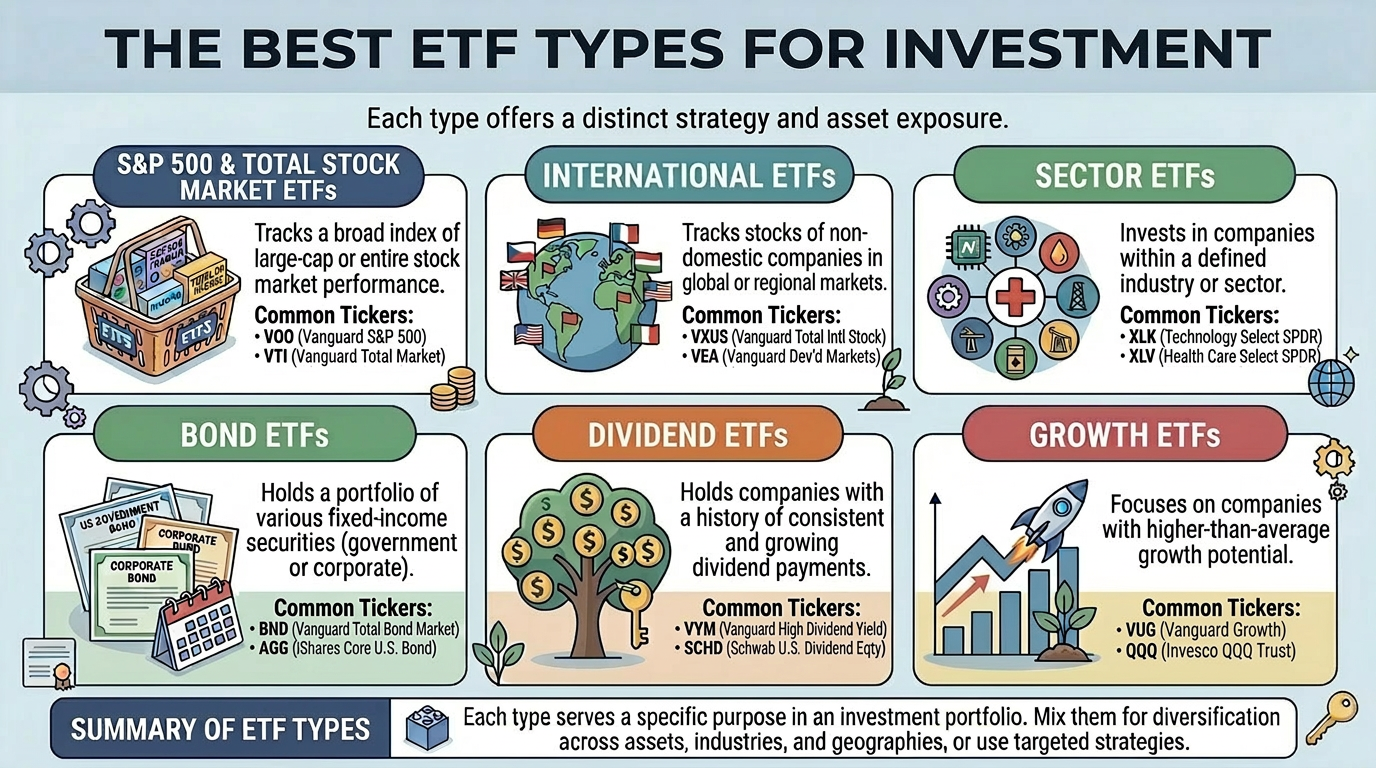
1. S&P 500 & Total Stock Market ETFs: The foundation of a portfolio
Examples (S&P 500): Vanguard S&P 500 ETF (VOO), SPDR S&P 500 ETF Trust (SPY), iShares Core S&P 500 ETF (IVV), Fidelity 500 Index fund (FXAIX)
S&P 500 ETFs track the 500 largest companies in the U.S., including big names like Apple, Microsoft, and Amazon. S&P 500 funds are by far the most popular choice for most investors. Investing in an S&P 500 ETF gives you exposure to a broad range of top-performing companies, which helps reduce risk compared to buying individual stocks. Historically, the S&P 500 has returned around 10% per year over the long term, making it a popular choice for steady growth.
Examples (Total Stock Market): Vanguard Total Stock Market ETF (VTI), Schwab U.S. Broad Market ETF (SCHB), Fidelity Total Market ETF (FSKAX/ITOT)
Total Stock Market ETFs include nearly all publicly traded U.S. companies, covering small, mid, and large-cap stocks. This gives investors even broader exposure than S&P 500 ETFs. Small companies may grow faster than big ones, which can boost overall portfolio growth—but they can also be more volatile.
Who should invest: Beginners or anyone seeking a “set it and forget it” investment with reliable long-term returns (as the name suggests, invest the money and you don’t need to worry about it anymore).
2. International ETFs: Investing Globally
Examples:
All countries excluding the US: Vanguard Total International Stock ETF (VXUS), iShares Core MSCI EAFE ETF (IEFA) - focuses mostly on developed countries
All countries including the US: Vanguard Total World Stock ETF (VT), iShares MSCI ACWI ETF (ACWI), iShares S&P Global 100 ETF (IOO).
International ETFs let you invest in companies outside the U.S., from Europe to Asia and emerging markets. This adds diversification, which can reduce risk if the U.S. economy underperforms, and opens up opportunities in fast-growing markets.
Who should invest: Investors seeking global exposure to balance their U.S.-focused holdings.
3. Bond ETFs: Stability and Income
Examples: iShares Core U.S. Aggregate Bond ETF (AGG), Vanguard Total Bond Market ETF (BND)
Bond ETFs are collections of bonds that trade like stocks. Bonds are loans to companies or governments that pay interest over time. They’re usually less volatile than stocks and provide regular income, making them a great way to balance risk in a portfolio.
Another option is a money market fund, which is often the default choice in many investment accounts. Like bond ETFs, these funds invest in bonds and Treasuries, but they focus on very short-term securities. This allows them to earn a small amount of interest while keeping the money highly liquid, essentially letting the fund function like cash you can access quickly.
Who should invest: Those seeking stability, income, or a safer portion of their portfolio, such as people approaching retirement.
4. Sector ETFs: Focus on Specific Industries
Examples: Technology Select Sector SPDR Fund (XLK), Health Care Select Sector SPDR Fund (XLV), Financial Select Sector SPDR ETF (XLF)
Sector ETFs focus on specific areas of the economy, such as tech, healthcare, or energy. They allow investors to target industries they believe will grow faster than the overall market. While they can have higher growth potential, they are also more volatile, since they rely on one sector’s performance.
Who should invest: People looking for higher growth and willing to accept more risk.
5. Dividend ETFs: Income and Growth
Examples: Vanguard Dividend Appreciation ETF (VIG), Schwab U.S. Dividend Equity ETF (SCHD), Vanguard High Dividend Yield ETF (VYM)
Dividend ETFs focus on companies that pay regular dividends, returning around 3% per year. They offer steady income and tend to include well-established, stable companies. Reinvesting dividends over time can significantly increase long-term returns.
Who should invest: Those seeking both growth and a steady income stream from their investments.
6. Commodity ETFs: Investing in Physical Goods
Examples: SPDR Gold Shares (GLD), iShares Silver Trust (SLV), United States Oil Fund (USO)
Commodity ETFs allow you to invest in physical goods rather than stocks or bonds. These can include metals like gold and silver, energy products like oil and natural gas, or even agricultural goods. Commodity ETFs can act as a hedge against inflation because the prices of these goods often rise when the cost of living increases. They also tend to move differently than stock or bond ETFs, which helps diversify your portfolio.
Who should invest: Investors who want to hedge against inflation, diversify beyond traditional stocks and bonds, or gain exposure to specific commodities.
ETF Investing Strategies
1. Core Satellite Strategy - Use a broad-market ETF as your core and add satellite ETFs for specific sectors, dividends, or international exposure. An example would be having an S&P 500 index as your core and then investing in technology and international ETFs are the satellites.
2. Dollar-Cost Averaging (DCA) - buying a set fixed-dollar amount of an asset on a regular schedule, regardless of the changing cost of the asset. This allows you to offset the risk of market volatility, as you don’t need to worry about buying at the very top of the market. Over time, DCA-ing allows you to average down to a lower average buy price.
3. Hedging - Using investments or strategies to protect your portfolio against potential losses from market downturns or specific risks. Hedging usually involves buying assets that tend to move in opposite directions. For example, Bond ETFs often rise when S&P 500 ETFs decline. By holding both, you can reduce overall portfolio risk because losses in one may be offset by gains in the other. The trade-off is that your total returns may also be lower, since gains in one ETF can be offset by losses in the other.
Summary
Building a strong ETF portfolio means combining different types of ETFs with strategies that suit your goals and risk tolerance. S&P 500 and Total Stock Market ETFs offer broad U.S. stock exposure, while international and global ETFs add diversification across countries. Bond and money market ETFs provide stability and income, and sector, dividend, and commodity ETFs allow targeted growth, income, or hedging against inflation. Using strategies like Core-Satellite Investing for balance, Dollar-Cost Averaging (DCA) to smooth out market volatility, and Hedging to reduce risk can help maximize returns while managing downsides. The key is to mix ETFs and strategies in a way that aligns with your personal objectives, creating a portfolio that is diversified, flexible, and positioned for long-term success.
