How to Choose ETFs: What to Look For Before Investing
Exchange-traded funds (ETFs) allow investors to buy a diversified portfolio of assets in a single trade. Because thousands of ETFs exist, choosing the right one requires evaluating a few key factors. This guide explains what to look at when selecting an ETF and how your personal investment goals affect the decision.
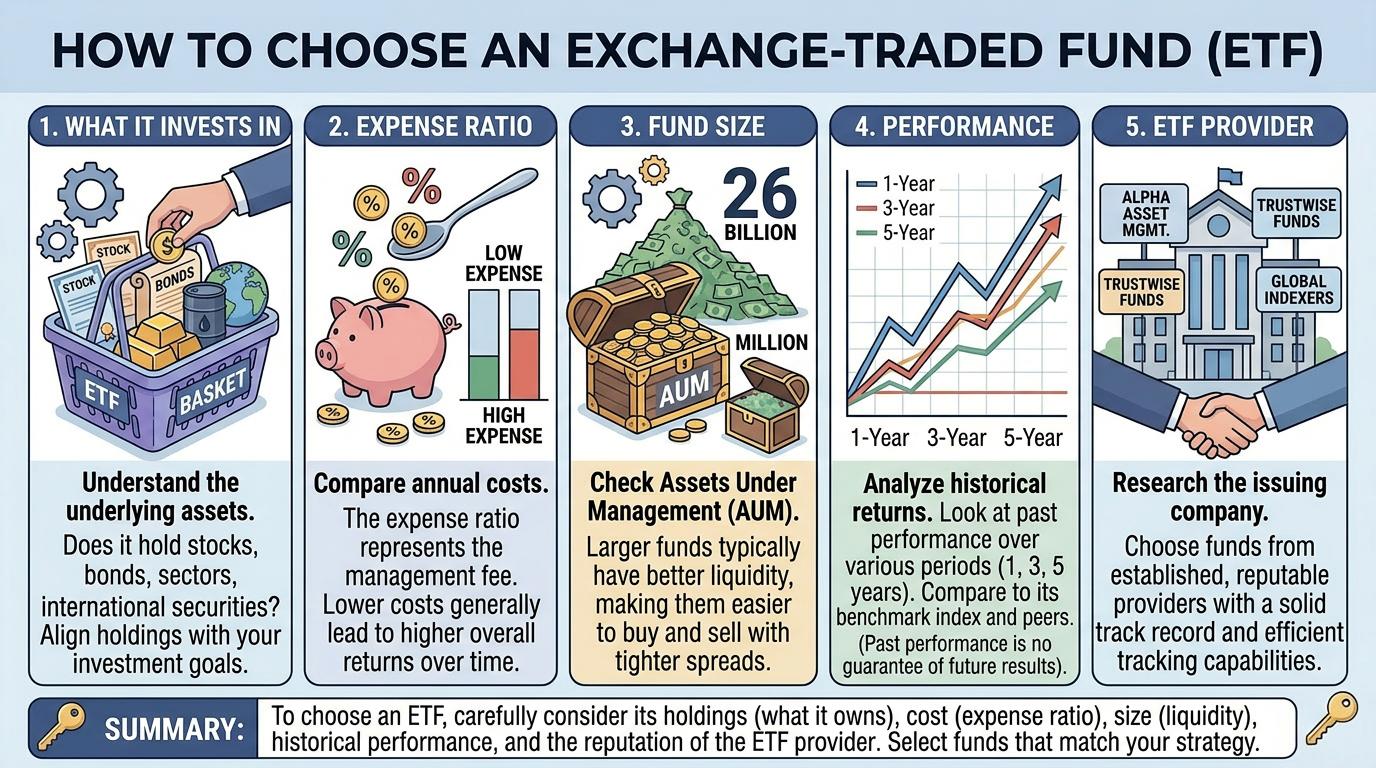
1. What the ETF Invests In
The most important factor when evaluating an ETF is its holdings (the components of the fund). Things to consider are:
1. The number of holdings (more holdings = more diversification = less risk)
2. Largest holdings (since holdings may be weighted differently)
3. Exposure to different risks (what things could potentially impact the holdings, and how severely?)
4. Asset class (stocks, bonds, commodities…)
2. Expense Ratio (Annual Cost)
The expense ratio is the annual fee charged by the manager of an exchange-traded fund (ETF) to cover operating costs, management, and administrative expenses. Broad index ETFs, which track major market indexes, typically have very low expense ratios ranging from 0.03% to 0.10%, while other types of ETFs, particularly actively managed funds, can have higher fees. For example, an expense ratio of 0.03% translates to roughly $3 per year for every $10,000 invested, whereas a 0.50% expense ratio would cost approximately $50 annually on the same investment. When comparing similar ETFs, choosing one with a lower expense ratio is usually advantageous, as lower fees reduce drag on returns and allow compounding to have a greater impact over the long term.
3. Fund Size (Assets Under Management)
Assets Under Management (AUM) represents the total amount of money invested in the ETF. Large ETFs usually manage billions of dollars. Fund sizes matter because larger funds typically offer: (1) higher liquidity - easier to trade, (2) lower trading costs, and (3) greater long-term stability. It is usually better to buy funds with higher AUMs.
In general, ETFs with >$1 billion AUM are usually very stable, ETFs with between $100 million & $1 billion AUM are moderately stable, and ETFs with AUM under $100 million may have a higher closure risk.
4. Performance
Though past performance is not representative of future performance, it is important to consider how the ETF has performed versus a benchmark index (such as the S&P 500 or NASDAQ). Usually, you want to invest in funds (both active and passive) that perform similarly or even outperform the benchmark indexes.
5. ETF Provider
The company that manages the ETF is also important to consider. Larger companies tend to offer funds that are more stable, have lower prices, and are more liquid (easier to trade). The largest ETF providers, ranked by AUM are: Blackrock ($4.01 Trillion), Vanguard ($3.95 Trillion), and State Street ($1.74 Trillion).
Summary
Choosing an ETF involves evaluating several key factors that affect diversification, cost, and reliability. Investors should first examine the ETF’s holdings, including how many assets it contains, its largest positions, and the types of risks those investments face. The expense ratio is also important, as lower fees help maximize long-term returns through compounding.
It is also useful to consider the ETF’s assets under management (AUM), since larger funds are typically more stable and easier to trade. Comparing the ETF’s performance to benchmark indexes can help show how effectively the fund tracks the market. Finally, the ETF provider matters, as larger providers often offer more liquid and lower-cost funds.
