A Simple Guide to Recessions & Depressions
The economy does not move in a straight line. Instead, it moves in natural waves known as the economic cycle. During good times, businesses grow, people easily find jobs, and overall wealth increases. However, what goes up must eventually come down. When the economy takes a step backward and the cycle points downward, we use words like recession and depression to describe the situation. These terms are often used interchangeably in casual conversation, but they represent very different levels of financial hardship for everyday people and businesses.
The Definition of a Recession
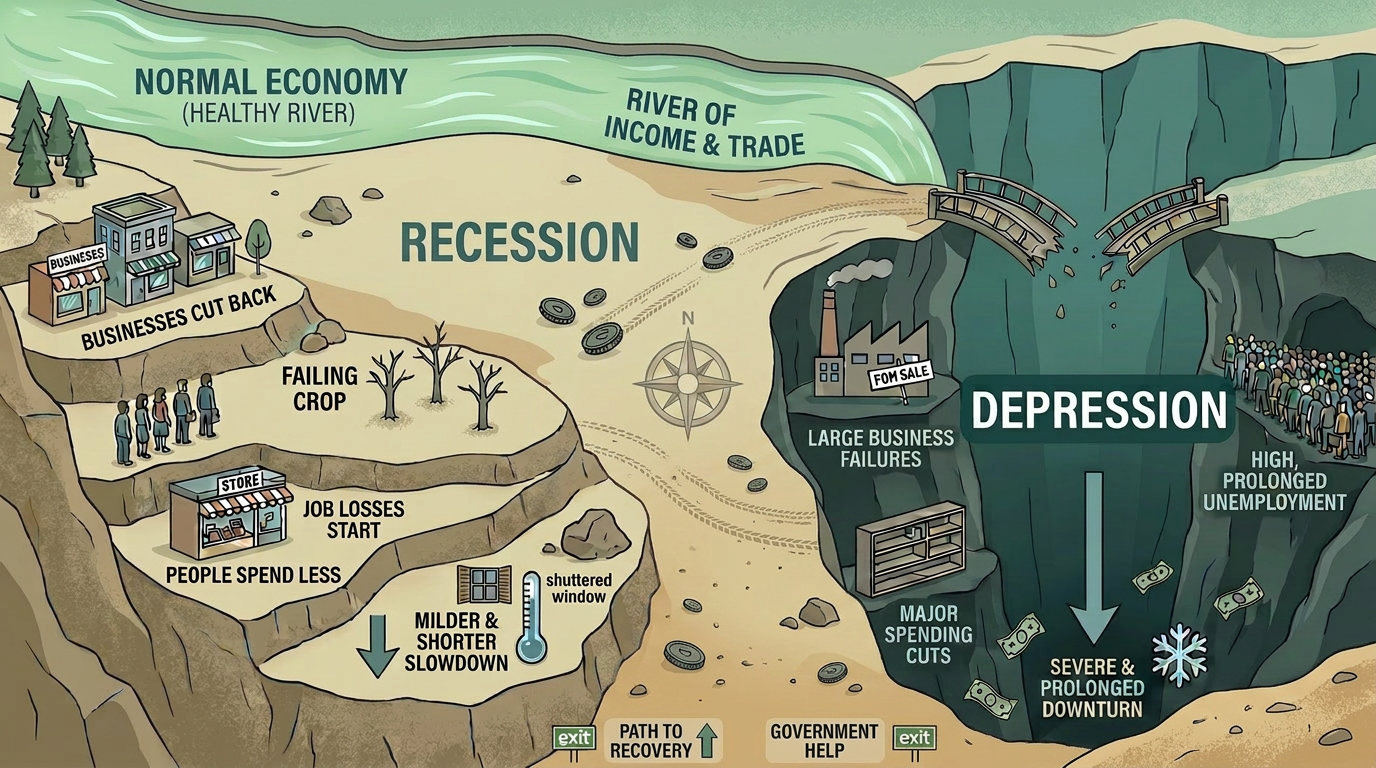
When the downward wave of the economic cycle begins, it usually starts as a recession. A healthy economy is like a car steadily moving forward. However, sometimes the car hits a steep hill and begins to roll backward. Economists generally define a recession as a period when the total amount of goods and services produced by a country shrinks for at least six months in a row. It is a temporary period of decline where business activity slows down across the board.
The Vicious Cycle of a Downturn
A recession usually begins with a specific trigger, such as a sudden shock to the banking system or a massive spike in the cost of essential resources.
Once the trigger occurs, it sets off a dangerous domino effect. If companies are struggling to make a profit, they start laying off workers to save money. When people lose their jobs, they immediately stop spending money on anything other than absolute necessities. Because everyday consumers are buying less, other businesses start losing money and have to lay off their own workers to survive. This repeating cycle of lost jobs and reduced spending is the core feature of any recession.
Crossing the Line into a Depression
While a recession is painful, a depression is catastrophic. There is no strict mathematical rule that officially turns a recession into a depression. Instead, the difference lies in the severity and the length of the financial pain.
A recession is typically measured in months and features a moderate rise in unemployment. A depression lasts for years, features massive and widespread job losses, and often includes the complete collapse of major industries and banks. If a recession is a temporary slowdown of the economic engine, a depression is a total engine failure.
The Only Two Depressions in Modern History
To understand how severe a total engine failure can be, it helps to look at the two largest economic depressions in recorded history. The most famous is the Great Depression, which began in 1929. Following a massive stock market crash, thousands of banks failed, and businesses across the globe shut down. At its worst point, roughly one in four American workers lost their jobs, and the bitter struggle lasted for an entire decade.
Before that, the world experienced what was known as the Long Depression. Starting in 1873, this massive downturn was triggered by the collapse of heavy railroad investments and widespread bank failures. It dragged on for over two decades in some parts of the world, causing massive unemployment and drastically changing how countries managed their money. Both of these events show just how devastating a prolonged economic stall can be to everyday life.
Pumping the Brakes on the Fall
Because these downward spirals cause immense hardship, the government steps in to try and reverse the momentum. The Federal Reserve will typically lower national interest rates to make borrowing money as cheap as possible. The goal is to encourage businesses to take out loans, expand their operations, and start hiring again.
At the same time, the federal government might step in with its own rescue plans. They might send stimulus money directly to citizens or start massive public construction projects to create new jobs. The entire purpose of these actions is to put cash back into the pockets of consumers so they can start spending at local businesses again, restarting the economic engine.
Summary
Recessions and depressions represent the difficult, downward phases of the normal economic cycle. A recession is a temporary period where a slowdown in spending leads to job losses and tighter budgets for several months. A depression is a severe, prolonged version of this same cycle that can devastate an economy for years at a time. By understanding how these downward spirals work, we can better grasp why the government takes drastic actions to keep businesses running and people employed during times of widespread financial crisis.
