Market Summary April 13 - April 17, 2026
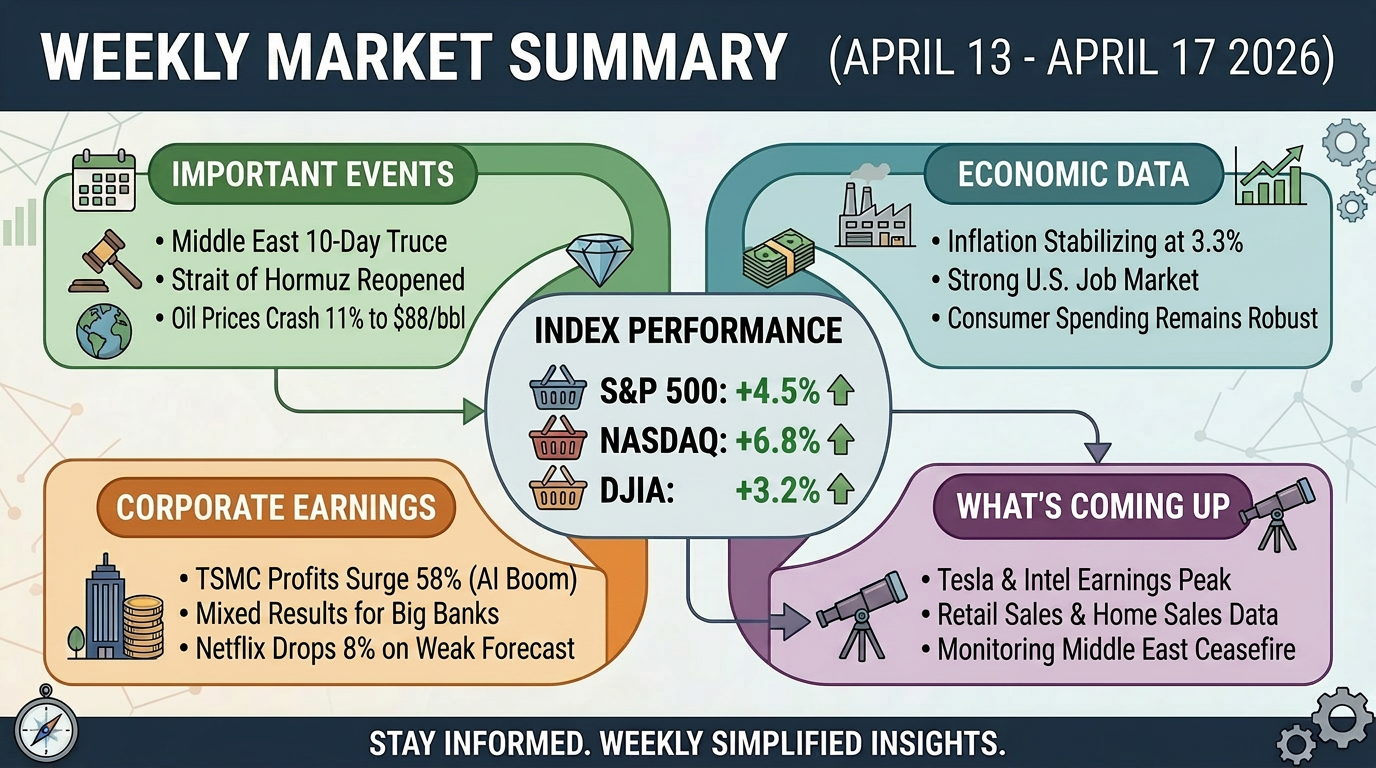
Market Summary
This week, the stock market enjoyed a powerful "relief rally," marking its best performance of the year so far. After a difficult few months where investors were worried about high prices and global conflict, a wave of optimism swept through Wall Street. The S&P 500 jumped 4.5% this week, crossing the 7,100 level for the first time ever to finish at 7,126. The tech-focused Nasdaq Composite saw an even bigger leap of 6.8%, helped by easing oil prices and continued enthusiasm around AI-related tech stocks. The Dow Jones Industrial Average also had a great week, rising 3.2% to finish at 49,447. This surge was enough to push all three major indexes back into "the green" for 2026, meaning investors have officially recovered their losses from earlier this spring.
Important Events
The primary driver of this week's relief rally was a major diplomatic breakthrough in the Middle East. On Thursday evening, a 10-day truce involving Israeli forces and Hezbollah in Lebanon officially went into effect. This was followed by even bigger news on Friday morning: Iran announced it was fully reopening the Strait of Hormuz, a narrow but vital waterway that carries about 20% of the world's oil. Because this waterway had been partially blocked during the fighting, its reopening caused US oil prices to crash by over 11% in a single day, falling toward $88 per barrel. For families, this is a huge relief because cheaper oil eventually leads to lower gas prices and makes it cheaper for companies to ship groceries and clothes.
Economic Data
The economic reports this week showed that while life is still expensive, the situation is starting to stabilize. A report released earlier this month showed that inflation in March hit 3.3%. A massive part of that jump was due to a 21% surge in gas prices during that month. However, because the price of oil fell so sharply this week due to the ceasefire, many experts believe that inflation will cool down significantly in the coming months. Other data showed that the American job market remains strong, and people are still spending money. This "strong but stable" data gives the Federal Reserve more room to consider lowering interest rates later this year if prices continue to behave.
Corporate Earnings
This week marked the first big wave of earnings, and while the results were mostly good, the stock market's reaction was mixed. JPMorgan Chase and Goldman Sachs both reported higher profits than experts predicted, with Goldman seeing a jump in revenue. Despite the good results, JPMorgan’s stock actually dipped slightly as investors took a "wait and see" approach. Other major banks also reported similar earnings. TSMC, the world’s largest chipmaker, reported a massive 58% profit increase because of the AI boom, which helped push tech stocks higher. Finally, Netflix reported earnings on Thursday after the market closed. Even though they reported solid earnings, their stock fell about 8% on Friday because investors were disappointed by their forecast for the coming months.
What’s Coming Up Next Week
Next week will be even busier as we reach the peak of earnings season. On Tuesday, UnitedHealth (UNH) will report its earnings before the market opens, and investors will be watching closely to see if the insurance giant can manage rising medical costs. On Thursday, Intel will share its earnings after the market closes, which will be a major test to see if the company can keep up with the massive demand for AI chips. We will also hear from other huge companies like Tesla and Johnson & Johnson. Most importantly, everyone will be watching the news over the weekend to see if the ceasefire in the Middle East holds. If the peace remains steady and oil continues to flow through the Strait of Hormuz, the market could maintain its record-breaking momentum on Monday morning. Lastly, we will also see key economic data on Tuesday with the Retail Sales and Pending Home Sales reports, followed by the S&P Global PMI health check for businesses on Thursday. These reports will show if the American consumer and local businesses are still staying strong despite the recent high costs.
