Market Summary April 6 - April 10, 2026
Market Summary
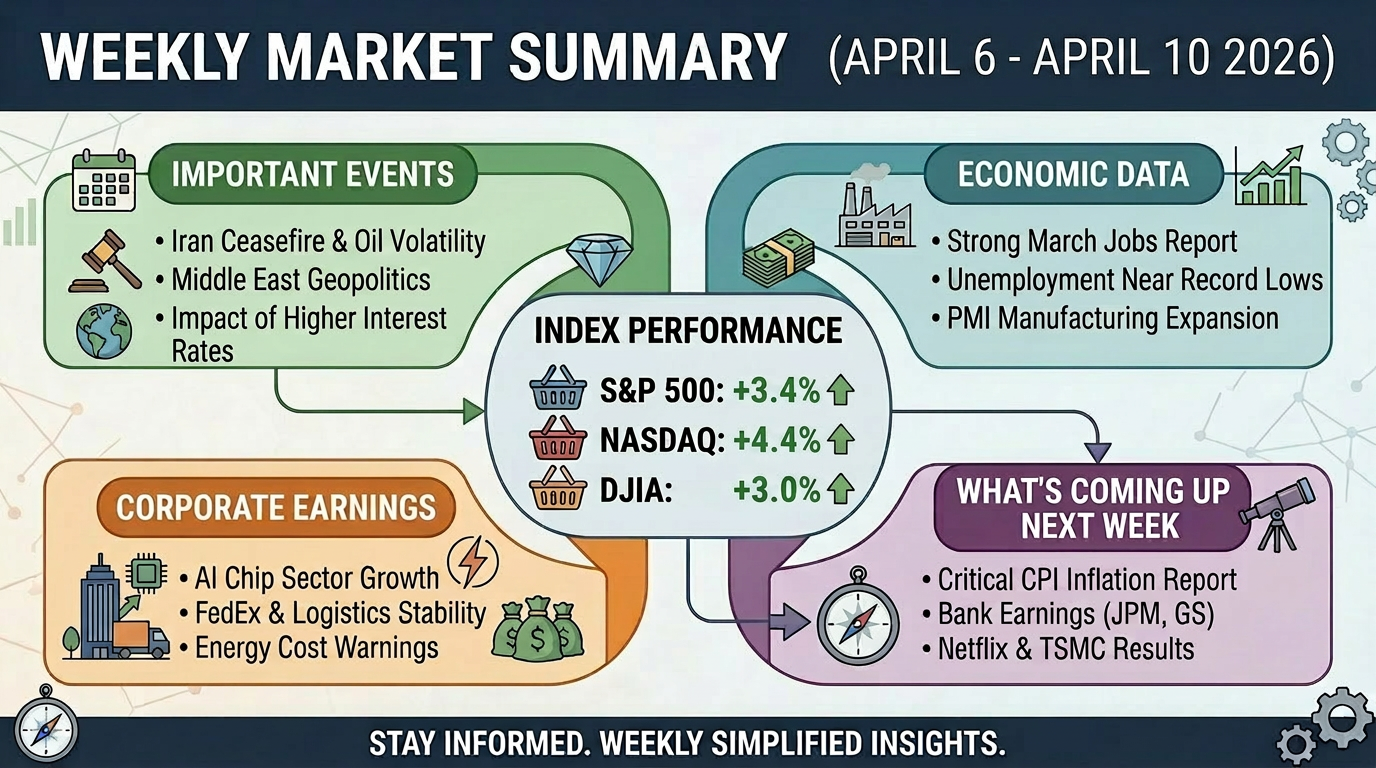
After a grueling month where stock prices dropped steadily for four consecutive weeks, the market staged a powerful turnaround to finish the week significantly higher. The S&P 500 climbed 3.4% over the last five sessions, while the technology-heavy Nasdaq Composite outperformed the broader market with a sharp 4.4% jump as optimism returned to the growth sector. The Dow Jones Industrial Average also participated in the recovery, posting a solid 3.0% gain for the week. Despite this burst of momentum, the year as a whole remains in "the red," meaning major indexes are still trading lower than at the start of the year. For 2026 so far, the S&P 500 is down 5.1%, the Nasdaq has retreated 6.9%, and the Dow Jones is down 5.8%.
Important Events
This week was a tug-of-war between bad news from overseas and good news about the U.S. economy. For the first half of the week, everyone was focused on the conflict in Iran. When news broke that a temporary ceasefire (a break in the fighting) had been reached, investors cheered. This caused the price of oil to drop back down toward $100 a barrel, which is a big deal because cheaper oil usually means cheaper gas and lower shipping costs for businesses. However, as we head into the weekend, there are reports that the fighting might be starting again, pushing oil prices back up to $105. At the same time, a government report released this morning showed that American businesses are hiring a lot more people than expected. Usually, "more jobs" is great news, but it makes investors nervous that the Federal Reserve (the "bank for banks") will keep interest rates high to make sure the economy doesn't overheat and cause more inflation. Higher interest rates increase the cost of borrowing for both businesses and consumers, which reduces corporate profits and dampens overall spending.
Economic Data
The main theme of the week’s data was that the American worker is staying busy. Today’s big jobs report showed that unemployment is still very low, which means most people who want a job have one. While that sounds perfect, it creates a tricky situation: when everyone is working and making more money, they spend more, which can keep prices high. Earlier this week, a report called the PMI showed that factories are still very active, but mostly because they are worried about the war in the Middle East causing shortages later. They are "stocking up" now just in case. We also saw that very few people applied for unemployment benefits this week. All of this tells us the economy is still moving fast, which makes it harder for the government to justify lowering interest rates anytime soon.
Corporate Earnings
Even though most big companies won't share their official scorecards until next week, we got a few early hints this week. Companies that make the computer chips used for Artificial Intelligence (AI) saw their stock prices go up as investors continue to bet that AI is the "next big thing." It seems that for many investors, the excitement over new technology is stronger than the fear of high interest rates. We also saw shipping companies like FedEx stabilize. When the price of oil dipped earlier in the week, it became cheaper for them to move packages, which is good for their profits. However, these companies warned that if oil stays expensive, they’ll have to charge us more for shipping, which could eventually make people buy fewer things.
What’s Coming Up Next Week
Next week is going to be a "make or break" period for the market. On Wednesday, we get a new report on inflation (the CPI), which tells us exactly how much more expensive groceries, rent, and clothes became in March. If that number is too high, the stock market might lose all the gains it made this week.
We will also see the first big wave of "Earnings Season," where major banks (JP Morgan, Goldman Sachs, Morgan Stanley…) and companies like Netflix, Johnson & Johnson, ASML, and TSMC will all report earnings (share their financial conditions & outlook for the future). Most importantly, everyone will be watching the news over the weekend. If the situation in the Middle East gets worse while the stock market is closed on Saturday and Sunday, we could see a very bumpy start when trading resumes on Monday morning.
