Hedge Funds: What They Are and How They Work
If you follow financial news, you may have heard about hedge funds making huge bets on the stock market or managing billions of dollars. Hedge funds are often talked about alongside famous investors and big Wall Street firms, but what exactly are they? And how are they different from normal investment funds like ETFs or mutual funds?
What Is a Hedge Fund?
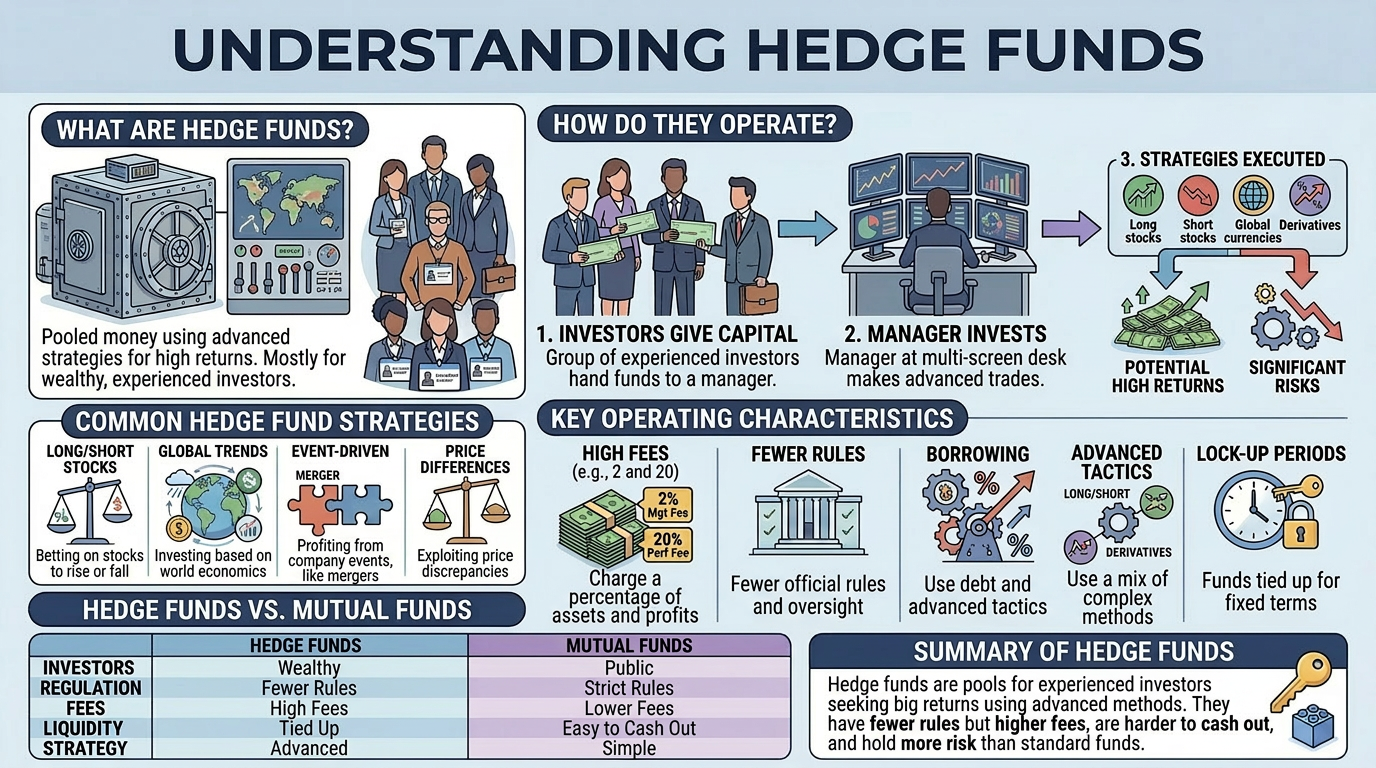
A hedge fund is a private investment fund (meaning most people cannot access it) that pools money from wealthy individuals or institutions and invests it using a wide range of strategies. The goal of a hedge fund is usually to earn higher returns than the overall market, often by using more complex or aggressive investment techniques.
Unlike mutual funds or ETFs, hedge funds are not available to most everyday investors. They are typically limited to accredited investors, meaning people with very high income or net worth, as well as institutions like pension funds and universities.
Hedge funds are also much less regulated than traditional funds, which allows them to try strategies that regular funds usually cannot use.
Why Are They Called “Hedge” Funds?
The word hedge comes from the idea of reducing risk by protecting against losses. In finance, hedging usually means making investments that offset each other. If the market moves unexpectedly, the losses from one investment may be reduced by gains from the other.
However, modern hedge funds don’t always focus on reducing risk. Many hedge funds actually take very aggressive positions in order to generate higher returns. Because of this, the name “hedge fund” doesn’t always perfectly describe what these funds do today. In some cases, they may actually take on more risk rather than less.
How Hedge Funds Invest
One major difference between hedge funds and normal funds is the flexibility of their strategies. Hedge funds can invest in almost anything, including stocks, bonds, commodities (gold, silver…), currencies, derivatives (things that derive their value from other things), private companies, and real estate. They use many strategies that other funds are unable to use, such as:
1. Short selling: betting that a stock will fall in price. Shorting works by borrowing shares, instantly selling them, and then buying them back at a lower price and returning the shares. For example, a company could borrow a share of a stock at $100 and sell it immediately for $100, but then buy it back later for $70 and repay the share. This allows them to make $30. If the share price increases though, and they need to buy it back for $130 to repay the share, then they will lose $30.
2. Leverage: borrowing money to invest in more than they actually have.
If a fund has $1 billion and borrows another $2 billion, they can invest with $3 billion. If their investments go up 1%, then they gain 3% on their actual money. If their investments go down 1%, then they lose 3% of their actual money. If investments go well, returns can be much higher. But if investments go badly, losses can grow quickly.
3. Event-Driven Investing: investing based on specific events, such as company mergers (literally just two companies merging together), corporate restructuring, bankruptcies, or spinoffs (when a division splits off from a larger company to create their own company). These events can create price changes that hedge funds try to profit off of.
4. Global Macro Strategies: making big bets based on economic trends around the world. They might invest in predictions about interest rates, currency changes, inflation, government policy, or economic growth. These funds often trade currencies, bonds, and commodities.
How do Hedge Fund Managers Get Paid?
Hedge funds usually charge much higher fees than ETFs or mutual funds. The classic hedge fund fee structure is called “2 and 20.” This means a 2% management fee per year on the total assets, with an extra 20% on profits as a performance fee. Because of this structure, hedge fund managers can become extremely wealthy if their funds perform well.
Famous Hedge Funds
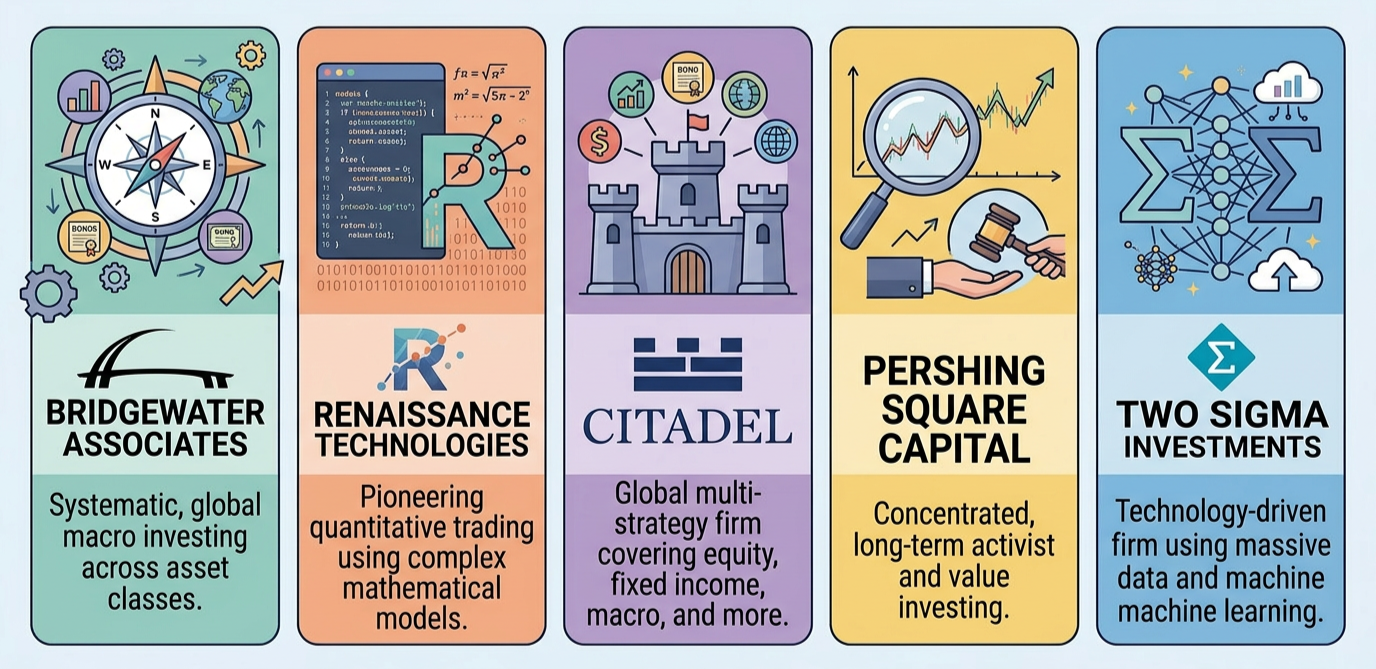
Over the years, several hedge funds have become well known because of their size, influence, and unique investment strategies. Many of these firms manage tens or even hundreds of billions of dollars, meaning their investment decisions can affect entire markets or industries. A few hedge funds in particular stand out for their performance, innovative approaches, and famous founders.
One of the most well-known hedge funds is Bridgewater Associates, founded by Ray Dalio in 1975. Bridgewater is one of the largest hedge funds in the world and is known for its global macro strategy, which focuses on large economic trends such as inflation, interest rates, and government policies. Its flagship fund, Pure Alpha, attempts to profit from changes in global economies rather than focusing only on individual companies.
Another famous hedge fund is Renaissance Technologies, founded by mathematician Jim Simons. Unlike many traditional investment firms, Renaissance relies heavily on mathematical models, algorithms, and data analysis to guide its trades. Its Medallion Fund is widely considered one of the most successful investment funds ever created, known for producing extremely strong returns over long periods of time.
Citadel, founded by Ken Griffin, is another major player in the hedge fund industry. Citadel manages investments across many markets, including stocks, bonds, commodities, and derivatives. The firm is also closely connected to Citadel Securities, one of the largest market-making firms in the U.S., which helps facilitate trading in financial markets.
Another notable hedge fund is Pershing Square Capital Management, led by investor Bill Ackman. Pershing Square is known for activist investing, a strategy where investors buy large stakes in companies and push for changes in management or corporate strategy in order to increase the company’s value.
Finally, Two Sigma Investments, founded by John Overdeck and David Siegel, is known for its heavy use of technology and data analysis. The firm uses advanced algorithms, machine learning, and large data sets to identify patterns in financial markets and guide its investment decisions.
Together, these firms show how hedge funds can take many different approaches, from economic forecasting to mathematical trading models, but all aim to outperform the market using specialized strategies and expertise.
Pros and Cons of Hedge Funds
Hedge funds offer the potential for high returns because they can invest in many different assets and use advanced strategies. They can also attempt to profit in both rising and falling markets, which is something traditional long-only funds cannot easily do.
However, hedge funds also have disadvantages. Their high fees can reduce the returns investors ultimately receive, and their strategies can involve significant risk. In addition, hedge funds are usually less transparent than publicly traded funds, meaning investors may not always know exactly how their money is being invested.
Conclusion
Hedge funds are private investment funds that use a wide range of strategies to try to generate strong returns. Their flexibility allows them to invest in many different markets and pursue opportunities that traditional funds may avoid. However, this flexibility also comes with higher risk, higher fees, and limited access for most investors.
While hedge funds can sometimes produce impressive results, many investors find that simpler investment options such as diversified ETFs and index funds offer a more accessible and reliable way to build long-term wealth.
