The Pulse of the Economy: Making Sense of the Unemployment Rate and the Job Market
Every month, news anchors and financial experts eagerly await the release of the national jobs report. For a few days, headlines are dominated by terms like job growth and unemployment numbers. But if you do not spend your days reading economic reports or analyzing the stock market, you might wonder why this data matters so much to everyone else. At its core, the job market is not just an abstract financial concept. It is a vital pulse check on the health of our society. To understand why it matters so deeply, we have to look at it through two different but deeply connected lenses: the everyday human impact and the financial ripple effect.
Decoding the Terms: What Are We Actually Measuring?
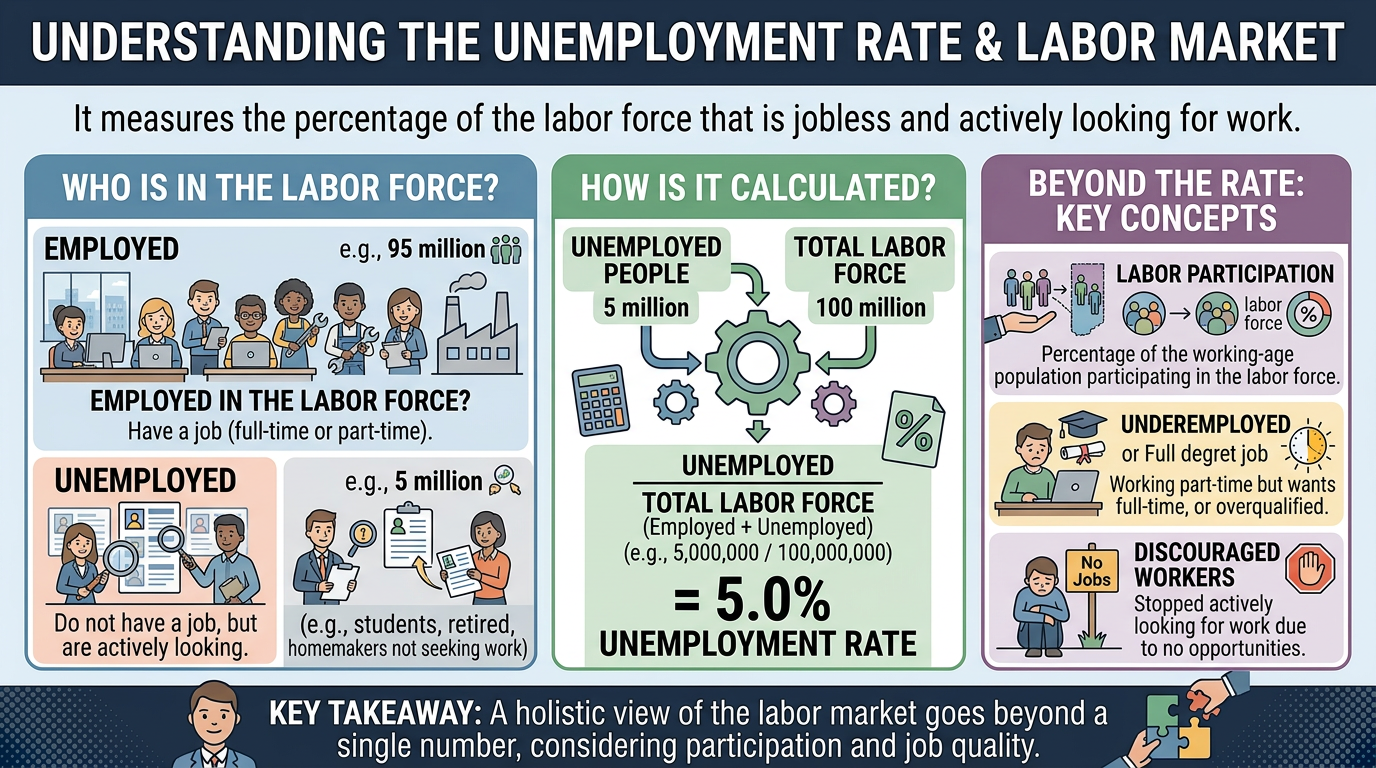
Before diving into why these concepts matter, it helps to understand exactly what they mean. Think of the job market as a giant matching system. On one side, you have employers who need specific tasks done. On the other side, you have people who have the skills and time to do those tasks. When the job market is "hot" or "strong," businesses are growing and desperate for workers. When it is "cold" or "weak," businesses are shrinking and letting people go.
The unemployment rate is simply the percentage of the labor force that does not currently have a job but is actively looking for one. For context, as of early 2026, the United States unemployment rate is sitting at roughly 4.3%. This single percentage point represents millions of individuals navigating this matching system at any given time, looking for their next opportunity.
The Human Impact: Beyond the Paycheck
When we talk about the unemployment rate, we are fundamentally talking about people. The most immediate impact of losing a job is the sudden loss of income. Paying for groceries, keeping the lights on, and covering rent or a mortgage quickly becomes a source of immense stress. However, the toll of unemployment goes far beyond a bank account balance. For many, a job provides a sense of daily routine, identity, and social connection. Stripping that away can lead to emotional and mental health challenges.
When a neighborhood experiences high unemployment, this pain is shared locally. Local businesses, like the corner diner or the neighborhood hardware store, see fewer customers because people simply do not have extra money to spend. This creates a deeply personal domino effect where one family's financial struggle inevitably chips away at the livelihood of their neighbors.
The Economic Engine: How the Job Market Drives Growth
To understand how the job market affects the broader world, it helps to think of the economy as a giant engine. The main fuel that keeps this engine running is consumer spending. When the job market is healthy and people are employed, they earn money. When they earn money, they buy things; everything from new shoes and movie tickets to cars and houses. When people buy things, companies make a profit. To keep up with demand, those companies grow and hire more people.
A rising unemployment rate throws a wrench directly into this engine. Millions of people suddenly stop spending money on anything other than basic necessities. Because people are buying less, companies make less money. To survive, those companies might have to lay off their own workers, creating even more unemployment. This vicious cycle is exactly how a weak job market can drag an entire country into an economic recession.
The Investor's Lens: Why Wall Street Obsesses Over Jobs
You might not own a portfolio of stocks, but the people who do are obsessively watching the unemployment line. The health of the job market is the ultimate crystal ball for the stock market because investors want to put their money into companies that are going to grow. As we established, corporate growth relies heavily on everyday consumers having money to spend.
When unemployment is high, investors know that companies will struggle to sell their products. Anticipating lower profits, they might sell off their investments, causing the stock market to drop. Conversely, when unemployment is low, wallets are full, cash registers are ringing, and companies are reporting record profits. Investors love this environment, and stock prices generally go up as people rush to invest in thriving businesses.
The "Goldilocks" Dilemma: Finding the Perfect Balance
You might assume that an unemployment rate of 0% would be the ultimate goal, but it can actually cause a completely different economic headache. When the job market gets too hot and almost everyone has a job, businesses have to compete fiercely to hire the few workers left available. To attract employees, they have to offer much higher wages.
While a bigger paycheck sounds great for the worker, businesses generally raise the prices of their goods and services to pay for those higher wages. If prices go up too fast across the board, the money in your pocket loses its buying power. This is known as inflation. To keep the economy balanced, the government steps in to cool things down or speed things up:
Cooling a hot market: If inflation is climbing, the government raises interest rates to make borrowing money more expensive, which slows down spending and hiring.
Warming a cold market: If unemployment is too high, they lower interest rates to make borrowing cheap, encouraging businesses to expand and hire workers again.
Summary
The unemployment rate is the ultimate bridge between our daily lives and the complex world of global finance. For the everyday person, the job market represents the ability to provide for a family and maintain peace of mind. For the investor, it is the fundamental indicator of whether businesses will thrive or struggle. The two are very closely linked. The stock market cannot thrive long-term if people are out of work and unable to participate in the economy, and communities cannot flourish if the economic engine grinds to a halt. By understanding the job market, you understand the very heartbeat of how our society sustains itself.
