How Supply and Demand Drive the Economy and Your Wallet
If you have ever wondered why concert tickets for a massive pop star sell out in minutes and cost a fortune on resale sites, while tickets for a local indie band are cheap and plentiful, you have already witnessed supply and demand in action. Or perhaps you have noticed that rideshare apps like Uber suddenly charge twice as much during a heavy rainstorm.
This is not random chance. It is the most fundamental law of economics at work. Supply and demand dictate the price of almost everything in the world, from the groceries in your fridge to the home you live in and the stocks in your retirement account. But what exactly are these two forces, and how do they impact your daily financial life?
What Are Supply and Demand?
To understand how prices are set, you have to look at the two sides of every transaction: the creators and the consumers.
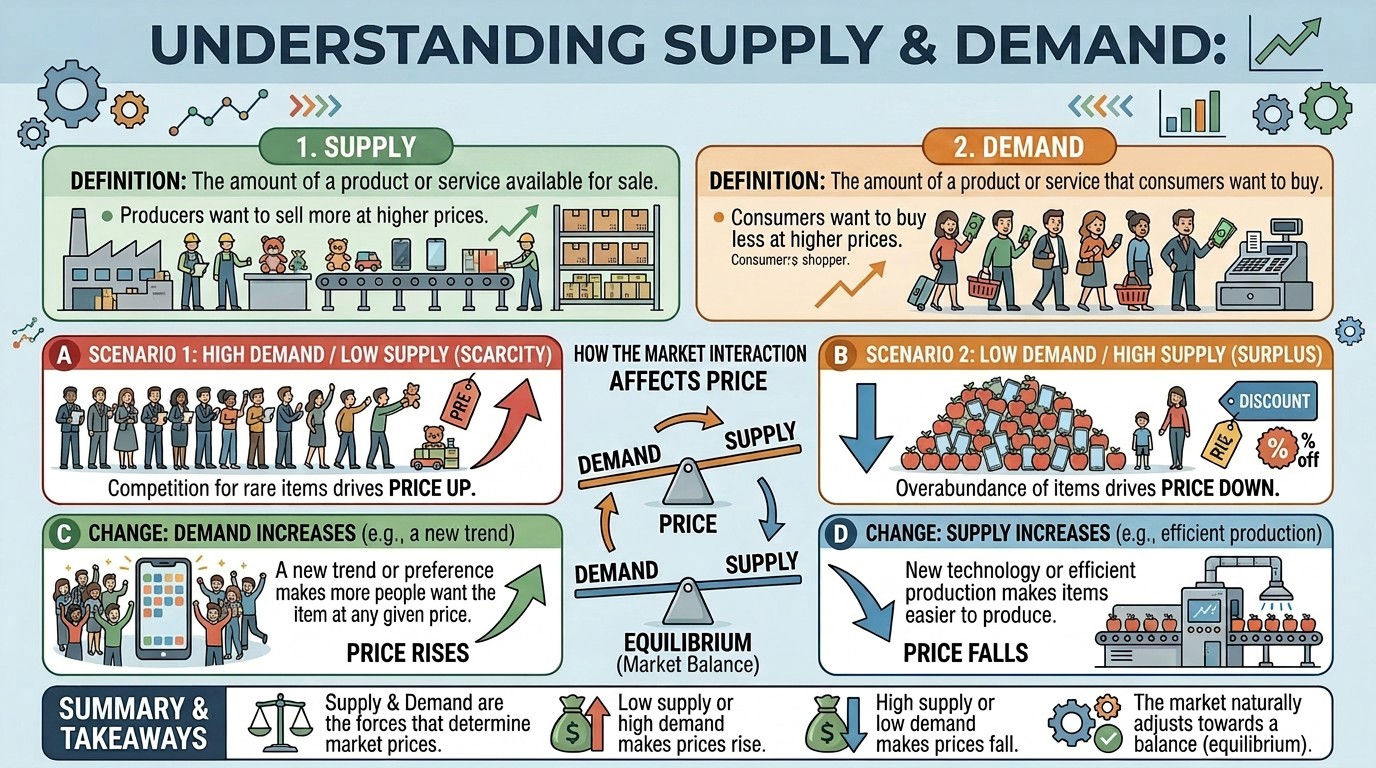
Supply represents the creators. It refers to how much of a specific product, service, or asset is actually available in the market.
Demand represents the consumers. It refers to how much people are willing and able to buy that product, service, or asset at a given time.
When you put these two forces together, they act like an invisible seesaw. The constant pushing and pulling between how much is available (supply) and how much people want it (demand) is what determines the final price of everything you buy.
How the Law of Supply and Demand Works
The relationship between these two forces follows a few very predictable rules. Understanding these rules helps you make sense of why prices fluctuate.
When Demand is High and Supply is Low, Prices Go Up: If a million people want to buy the newest video game console, but the manufacturer only produced 100,000 units, the console becomes rare. Because buyers are competing for a limited number of items, sellers can raise the price, knowing people are willing to pay more to get it.
When Supply is High and Demand is Low, Prices Go Down: Imagine a clothing store that ordered too many heavy winter coats, and suddenly it is the middle of spring. The store has a massive supply, but nobody wants to buy a winter coat in warm weather. To get rid of the inventory, the store has to drop the price and offer deep discounts.
Equilibrium (The Sweet Spot): In a perfectly balanced market, supply perfectly matches demand. There are just enough products for everyone who wants to buy them, and prices remain stable. However, in the real world, the market is constantly shifting, meaning true equilibrium is rare.
Real-World Examples You See Every Day
Supply and demand is not just an academic theory; it plays out constantly in your everyday life and in the broader economy.
The Housing Market: When mortgage rates are low and people are eager to buy homes (high demand), but very few current homeowners are selling (low supply), the market becomes highly competitive. Buyers start bidding over the asking price, driving the overall cost of real estate up.
Your Paycheck: Supply and demand also applies to your career. If you possess a highly specialized skill, like artificial intelligence programming, and thousands of companies are desperate to hire someone with that skill, your wages will be incredibly high. You are in low supply and high demand. Conversely, if a job requires no prior experience, the supply of potential workers is massive, which generally keeps the starting wages much lower.
Why It Matters for Your Investing
If you are going to invest in the stock market, understanding supply and demand is absolutely critical. In fact, a stock exchange is essentially just a giant supply and demand engine.
When a company releases an amazing earnings report or announces a revolutionary new product, investors get excited and want to buy the stock (demand goes up). Because there are a set number of shares available (supply), the buyers have to offer higher prices to convince current owners to sell, causing the stock price to climb. On the other hand, if a company gets caught in a scandal, investors panic and want to sell (supply of available shares floods the market). With very few people wanting to buy (low demand), the stock price plummets.
Summary
Supply and demand is the invisible heartbeat of the global economy. It is the underlying reason behind inflation, the housing market, stock prices, and the cost of your everyday purchases. By understanding how this seesaw works, you stop being confused by wild price changes and market fluctuations. Instead, you can anticipate economic shifts and make smarter purchasing decisions.
